Home / Unprocessed trauma in relationships: We’re fighting about what’s happening now, my body is responding to what happened then

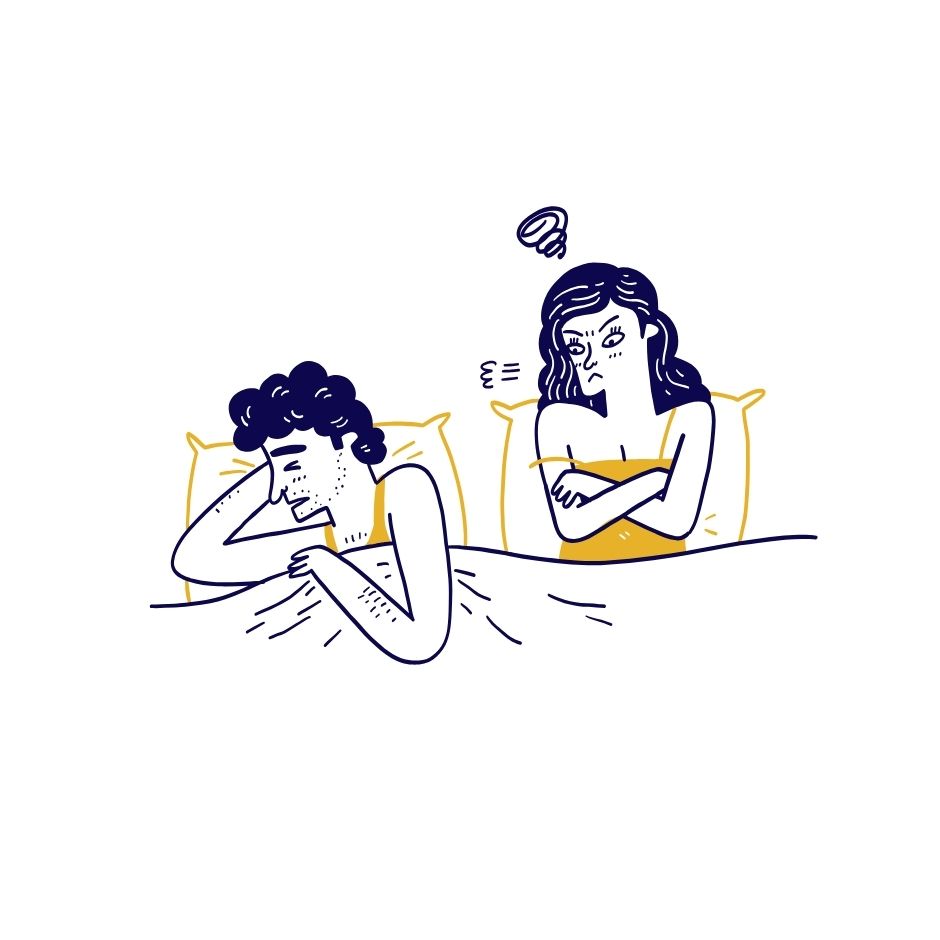
He doesn’t respond to the message for several hours. By the time he comes home, she is already storming. For her, those hours tell something about her place in the relationship. He walks in and meets anger, accusations, and questions. For him, he was simply busy.
Both are in the same house on the same evening, and each meets a different reality. The message truly remained unanswered. That is a fact belonging to the present. Within it, a much more familiar experience can also arise: I am not seen, I cannot trust the one I love, in the end I will be left alone.
When unprocessed trauma meets an intimate relationship, something is happening between us now and something within me recognizes this feeling from somewhere else. The ability to distinguish between the two layers can change the way we meet the fight.
Intimacy brings us close to our most vulnerable places. We attach, lean, need, expose ourselves, and give another person a significant place in our lives. The more important they are to me, the more power what happens between us holds. It is precisely the person close to us who can stir childhood wounds created long before we knew them.
Distance can trigger fear of abandonment. Criticism can meet old shame. Silence can be experienced as a threat to the relationship. A change in plans can stir helplessness, and a partner’s request to take space during a fight can meet a place that knows well the fear of being left alone.
The response can happen quickly. The pulse rises, breathing changes, muscles contract, and attention narrows. In such a moment it becomes harder to hold a complex picture of the person before me and of what is happening between us. The partner meets this response and sometimes reacts to it even before we both understand what has been triggered.
Within couple conflict, I am interested in the gap between what happened and the intensity that arose. He forgot something that was important to her, and within her the sentence immediately appears: “I am never important to anyone.” She asks to pause the conversation for a few minutes, and he already feels she is on her way out of the marriage. Abandonment wounds in relationships can turn even temporary distance within the relationship into a powerful experience of danger and loss.
This intensity can be a clue that the present moment has met a place that already knows pain. It invites me to take interest in what has been stirred, without rushing to conclude that everything I am feeling now belongs to the past.
If my partner spoke to me with contempt, there is room to address the way he spoke. If he violated an agreement between us, there is room to speak about the violation. My history does not erase what is taking place in the relationship today.
This is a distinction I return to in work with couples. A partner says to her partner during a fight: “It’s impossible to talk to you. You’re just like your father.” A hurtful sentence has been spoken. That is one layer of the event.
Within the partner, another layer can arise. Perhaps he grew up in a home where he was humiliated when he expressed emotion. Perhaps a mistake immediately turned into shame. Perhaps he knows from childhood the feeling that he is never good enough. In this moment he meets both his partner and something familiar from within himself.
When he is able to identify the two layers, the possibility opens before him to respond more precisely. He can say he was hurt by the way she spoke to him and ask her not to speak to him that way. At the same time, he can recognize that the intensity that arose in him also tells something about his history.
The story we bring to the relationship begins long before the relationship itself, and sometimes it also touches what has passed in the family from generation to generation. About intergenerational trauma and the way family pain can continue to affect future generations, I wrote here.
Differentiation allows me to be in relationship with you and remain in relationship with myself. To see you, your behavior and my boundaries, and at the same time to recognize what you stir in me.
One feels the relationship is in danger and moves closer. He asks, demands an answer, sends another message, and wants to resolve everything now. The other feels flooded and pulls away. He falls silent, closes off, leaves the room, or asks to stop the conversation.
The distancing intensifies the fear. The fear intensifies the pressure. The pressure intensifies the need to distance. Within a short time, a cycle has formed between them in which each person’s way of protecting activates the other even more.
“You always run away from me.”
“You don’t let me breathe.”
“You don’t care about me.”
“It’s impossible to talk to you.”
Each of them is describing something they truly experience, and each of them is also influencing what happens to the other. When we manage to see the cycle, the question changes. Instead of focusing only on who started, we can also take interest in what is happening between us when we both feel threatened.
Familiarity with my history can help me understand why a small distancing stirs great fear in me, why criticism floods me with shame, or why it is hard for me to remain present within conflict. This understanding is important. My responsibility begins with what I do with what has been stirred.
If abandonment fear leads me to check my partner’s phone, I can give space to the fear and take responsibility for the invasion of his privacy. If conflict floods me and I need distance, I can acknowledge the flooding and learn to take space in a way that also protects the relationship. If criticism activates an old wound in me and I respond with humiliation, I can understand where the intensity came from and see the harm I created.
The past provides context. The responsibility for the way I act rests in my hands today. For me, this is a meaningful movement in healing within relationships: to understand myself better, and from that understanding to expand the possibility of choosing.
Before we manage to explain to ourselves what happened, the body can already signal that something has changed. The heart beats faster, breathing shortens, the belly contracts, heat appears in the chest or face. An urge to flee, attack, prove, cling, or immediately end the conversation can arise.
In such a moment, the ability to listen and hold complexity narrows. It is possible to recognize this in time and say to myself: “I am flooded right now.” About emotional flooding and ways to work with it through the body, relationship, and roots, I wrote extensively here.
It is possible to feel the soles of the feet on the floor, notice the backrest holding the back, look around and see the room I am in, and let the exhale lengthen a bit.
I do not have to resolve the relationship from within the moment when my body is convinced it is in danger. It is possible to create a bit of space, and then return to the conversation with more ability to choose.
When old pain arises, it is easy to see the partner through what has already happened to us. He distances, and I already meet the one who left. She criticizes me, and I already feel the one who humiliated. He falls silent, and I am already inside the house where no one spoke about what hurt.
The present and the past draw very close to each other. I can turn my gaze again to the person who is before me. We have our own history. There are things he does that hurt me, there are ways in which he is different from the people who hurt me in the past, and I have the possibility to learn him from within the relationship we truly live in.
He too can understand that my response touches a deep place and still maintain his boundaries. Compassion toward the pain does not require accepting behavior that harms him. Closeness can hold two whole people.
It is best to do this exercise after the intensity has already subsided a bit. Take a sheet of paper and divide it into three parts.
1. What actually happened?
Write the event as a camera would have recorded it: “He didn’t answer the message for four hours.” “She said she wants to stop the conversation and left the room.” “He raised his voice.”
Stay for a moment with the facts, before you add to them the meaning you gave to what happened.
2. What arose in me?
Write the experience that arose following the event: “I felt I am not important.” “I was afraid she is about to leave me.” “I felt again like the girl no one listens to.”
Notice the body as well. Where do you feel this experience now? There is no need to know immediately where it came from. It is enough to recognize what has been stirred.
3. What is my responsibility now?
Look again at the two layers you wrote. It may be that there is something you want to ask of your partner, set a boundary, apologize for the way you responded, or say more clearly what you need. It may be that this response is familiar to you from other relationships and you want to understand it more deeply.
You can finish with a sentence:
“This is what arose in me. Now I choose how to meet you.”
We come to relationships with everything we have learned about closeness, safety, love, danger, abandonment, and trust. The partner arrives with their story. When the two stories meet, the fight happening today can touch places created long before we knew each other.
Couples work invites us to recognize when the past is with us in the room and to also see the person who is before us now. I can listen to what has been stirred in me and take seriously what is happening between us. I can understand my pain and bear responsibility for the way I bring it into the relationship.
As this distinction becomes clearer, the past remains part of my story, and I can choose how I want to be in relationship today.

+
For people without a supportive family network.
We will reveal how the lack of a family network challenges and strengthens the couple's relationship, the high prices it exacts from you and your relationship.
Couples therapy will strengthen your sense of security and belonging, so you can be close without losing yourselves along the way.
Online / In-person clinic

+
Individual therapy is a safe space where you will rediscover your strengths, build inner confidence, and create a whole and meaningful life for yourself, just as you dream.
Online / In-person clinic
+
You are invited to enter a unique space: an interactive conversation with special GPTs I created – a first-of-its-kind tool that looks inward with you in the language and frequency of the systemic constellation.
If there is something unresolved in your relationship, family, or heart – the chat will gently meet you without trying to fix it, inviting a different, slow, precise, and quiet perspective. There is no need to understand, just to see and let it work.
Expert in couples therapy for relationships without a supportive family safety net.
Developer of the Couples Constellation approach: a systemic-emotional therapy that brings the couple’s relational dynamics into contact with unspoken family patterns, alongside practical tools that enable movement, connection, and the creation of a deep partnership.




Let’s start with a brief introductory call, free of charge and commitment.
Sometimes, this small step changes everything.
The sessions take place
online via Zoom / face-to-face in Tivon, according to your choice