Home / Abandonment Wounds in Relationships: When the Fear of Being Left Starts to Run the Relationship
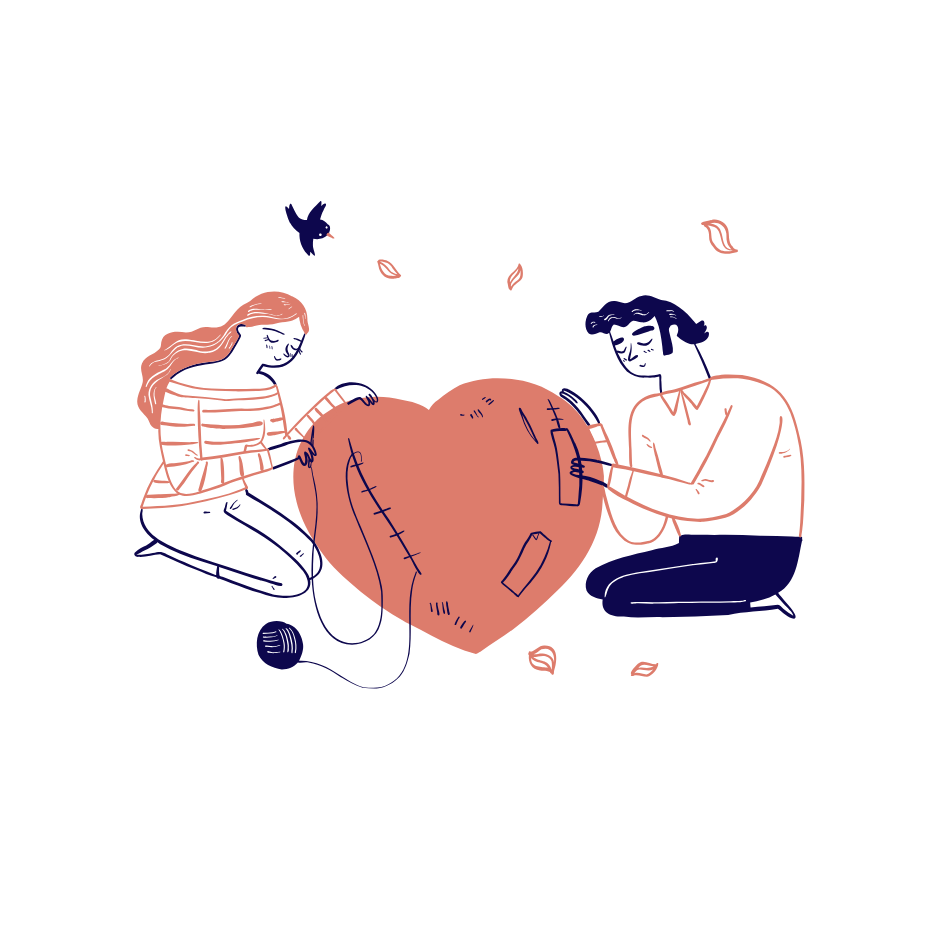
An unanswered message. A partner quieter than usual. She comes home late and doesn’t call. He asks for an evening to himself. From the outside these can be small events within a relationship. From the inside they can feel like the beginning of disaster.
When fear of abandonment arises inside a relationship, I don’t always think in words “He’s about to leave me.” I simply feel that something has changed. I become more vigilant, start checking, interpreting, looking for signs. I want to know that we’re okay, that the relationship is safe, that you still love me.
The fear itself deserves listening. In couples therapy I’m also interested in the question of what I start doing with you when this fear arises. Am I asking you for closeness, or do I need you to behave in a certain way so I can calm down? The difference between them can be small from the outside and very deep inside the relationship.
A meaningful relationship touches a deep need for closeness, belonging, and safety. The more significant the person in front of me becomes, the greater the meaning of the possibility of losing them.
For someone who has experienced leaving, loss, instability in the past, a parent who wasn’t emotionally available, or a relationship where love was unpredictable, situations of distance in the present can take on particular intensity. An event happening now may also meet an earlier experience inside me.
The past helps me understand the intensity of my experience. It still doesn’t tell me what’s actually happening right now in the relationship. My fear is real, and the interpretation born from it still needs checking. I can feel that he’s pulling away from me, without yet knowing that this is really what’s happening.
This is a significant distinction for me: I can give full space to what I’m feeling without immediately turning the feeling into fact. A partner can be quiet because he’s angry, tired, preoccupied, or needs space. He can also truly be distant from me. To understand what’s happening between us, I also need to meet the present reality. About the way trauma from the past can enter present relationships and affect how we interpret our partner, I wrote here.
I can say to you: “I feel distant from you today and I’d like to come closer.” There is me in this request and there is also room for you. I bring my need and leave you the possibility of being a person separate from me.
Fear of abandonment can change the request. I now need you to come closer to prove to me that I have no reason to fear. I look for reassurance, check your tone and response time to messages, struggle to bear your need for space, or give up things that matter to me so it will be easier to stay with me.
I can also do almost the opposite. Pull away first, shut down, grow cold, or say “So maybe we really should break up” before we’ve even talked about breaking up. This too can be a way of trying to gain control over the possibility that frightens me, of being the one who is left.
Beneath the different behaviors, the same hope can be operating: if I manage the distance between us correctly, maybe I can prevent you from leaving me. At this point the fear becomes a couple dance. The more I demand certainty, the more you may feel that no answer will be enough. The more I cling, the more space you ask for. The more you distance, the more I see it as proof that I was right to be afraid.
You also bring something of your own to this dance. It may be hard for you to bear need, anger, or expectation, and distancing may be your way of dealing with tension. So I’m less interested in who started. I’m interested in the question: what is each of us trying to get the other to do so that we ourselves can feel differently? This is also the point where responsibility becomes important. I’m not responsible for the fear showing up, and I am responsible for what I do with it inside the relationship. The fear can explain my behavior. It can’t make the decision for me about how to behave toward you.
Working with abandonment wounds isn’t supposed to turn every pain into a problem from the past. There are relationships where a partner truly is pulling away, isn’t available, threatens to leave during fights, repeatedly avoids conversation, or maintains an unstable connection. In such situations my anxiety can also be connected to what’s happening between us now. So I don’t want to teach a person with an abandonment wound to automatically doubt themselves. I want to help them see more clearly: what I bring with me, what you’re doing now, and what happens between us when the two meet.
I can ask you to call when you’re running late. Say that it’s hard for me when you disappear in the middle of a conflict. Set a boundary around repeated threats of breaking up. My needs don’t lose their validity because I have an abandonment wound. And within all of this I can check what belongs to your responsibility toward me and what I’m asking you to do so I won’t have to meet something that’s hard for me to bear inside myself. About differentiation and the possibility of staying in deep connection with another person while continuing to be connected also to myself, I wrote here.
The more occupied I am with the question of whether you’ll stay, the less I may ask whether I’m good with you. This is one of the deep costs of fear of abandonment. I can be so occupied with your choice of me that my choice of you almost disappears. I check whether you want me and forget to check whether I want the way we live together.
I can stay in a place that doesn’t suit me because leaving feels more frightening than the price I pay to stay. I can give up voice, need, or boundary and feel that I’ve succeeded in keeping the love.
Here the abandonment wound meets the question of worthiness. I want you to choose me, and at the same time I want to remember that I too am a person who chooses. My value isn’t determined only by your response to me. About what happens when the relationship is required to also carry the need for belonging and safety that we didn’t receive in our family of origin, I wrote here.
Differentiation isn’t absolute independence; I’m not aiming to reach a place where I don’t need you. People need connection. We want to be sought after, missed, soothed, and stayed with in difficult moments. I can need you and still hold myself within the need. I can say “I’m scared right now and I’d like you to be with me.” I can be disappointed if you can’t respond to my request as I’d hoped. I can be angry, check what your response means for me, and decide what I want to do with it. My need deserves space. The person facing me also remains a person separate from me.
This exercise is for a moment when something in the relationship activates the fear of abandonment: an unanswered message, distance, silence, a request for space, or a feeling that something has changed.
The goal is to create a little space between what I’m feeling and what I’m about to do.
Place the soles of your feet on the floor and notice the support beneath your body.
You can place a hand on your chest or belly, wherever the fear is felt right now.
Stay like this for a few moments without trying to change the feeling.
Say to yourself quietly:
“I’m feeling fear right now of being left.”
And then:
“My fear is real. I still don’t know what it says about what’s happening between us.”
Now check four things:
What am I feeling?
Try to name the experience itself: fear, loneliness, anger, hurt, helplessness, longing.
What am I telling myself is happening?
What am I about to do to make the fear disappear?
Send another message, demand an answer, check, please, grow cold, disappear, threaten to break up, or give up something that matters to me.
What do I really want to ask of you?
It may be that beneath everything I was planning to do lies a simpler request:
The exercise isn’t asking me to stop needing my partner. It helps me arrive at my need more clearly. Instead of acting immediately to make the fear disappear, I can recognize it, hold it long enough, and choose how I want to turn toward the person I love.
I want you to choose me, I want to know that our relationship matters to you, I want you to stay. Healing abandonment wounds doesn’t turn me into a person who doesn’t need love. It allows me to bring my need into the relationship without handing over the management of the relationship to fear. I want you to stay, and I want the fear that you’ll leave not to be the one deciding for me how to love you.

+
For people without a supportive family network.
We will reveal how the lack of a family network challenges and strengthens the couple's relationship, the high prices it exacts from you and your relationship.
Couples therapy will strengthen your sense of security and belonging, so you can be close without losing yourselves along the way.
Online / In-person clinic

+
Individual therapy is a safe space where you will rediscover your strengths, build inner confidence, and create a whole and meaningful life for yourself, just as you dream.
Online / In-person clinic
+
You are invited to enter a unique space: an interactive conversation with special GPTs I created – a first-of-its-kind tool that looks inward with you in the language and frequency of the systemic constellation.
If there is something unresolved in your relationship, family, or heart – the chat will gently meet you without trying to fix it, inviting a different, slow, precise, and quiet perspective. There is no need to understand, just to see and let it work.
Expert in couples therapy for relationships without a supportive family safety net.
Developer of the Couples Constellation approach: a systemic-emotional therapy that brings the couple’s relational dynamics into contact with unspoken family patterns, alongside practical tools that enable movement, connection, and the creation of a deep partnership.



Let’s start with a brief introductory call, free of charge and commitment.
Sometimes, this small step changes everything.
The sessions take place
online via Zoom / face-to-face in Tivon, according to your choice