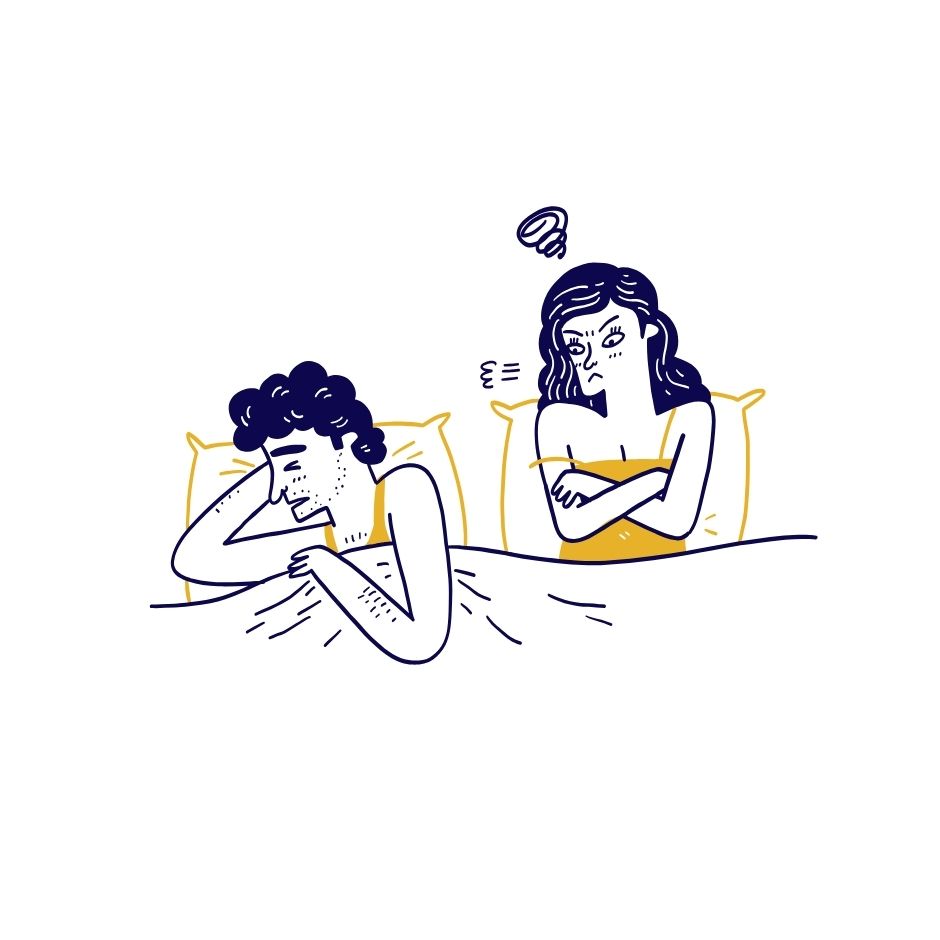
I meet couples in the clinic who have love between them. They chose each other, built a shared life, are committed to the relationship, and invest in it. They talk, try to understand, read, learn, and work on themselves. And yet, the same fight returns, the same hurt opens up, the same feeling that one of them seeks closeness and the other pulls away.
I call the way I integrate family constellation with differentiation and entitlement in couples work couples constellation therapy. Within this work I’m also interested in the question: From what place does each partner meet the other?
Am I standing before my partner as an adult woman and as his partner? Have I become over the years the one who manages him, takes care of him, educates him, or rescues him? Am I meeting my partner as a woman I chose to live with, or giving her the responsibility to calm me, hold me, and reassure me again and again that the relationship is safe?
These questions relate to a central concept in Bert Hellinger’s work: orders of love in relationships and family.
For me, orders of love are not a system of rules to obey. They are a lens through which it’s possible to look at relationships and see what happens when a person occupies for a long time a place that isn’t theirs, and what begins to become possible when each person returns to stand in the place that fits them within the system.
In a relationship this question becomes especially significant. Two people arrive from two different family systems and seek to create a new system together.
What are orders of love in relationships and family constellation?
Bert Hellinger described several systemic principles he repeatedly encountered in his work with families. He dealt with belonging to the system, order between generations, and the movement of giving and receiving within relationships.
These are principles that grew out of Hellinger’s constellation work. I relate to them as a lens for observing the system, not as laws that allow us to determine from the outside how a family or relationship should look.
The principle of belonging suggests recognizing that whoever was a significant part of the system belongs to its story. Parents, children, former partners, and people whose fate deeply affected the family are not erased from family history even when it’s difficult to talk about them.
Order between generations distinguishes between the place of parents and the place of children. Parents came before the children and gave them life. The child receives life from them, and later goes out to their own life.
When a child is required over time to hold one of the parents emotionally, mediate between parents, be responsible for their well-being, or occupy a place larger than is appropriate for a child, something in the family order becomes more complex.
Between partners the movement is different. Both partners are adults. Both give and both receive.
This reciprocity is not accounting. At certain times one will give much more. Illness, birth, loss, professional crisis, or a difficult emotional period can shift the balance for an extended time. A relationship allows us to lean on each other.
The question is what happens when a temporary situation becomes a permanent structure, and one partner becomes over time the parent, caregiver, rescuer, or holder of the other.
When I’m no longer standing before you as a partner
A woman says to her partner: “I feel like I have another child at home.” You can hear in this sentence a complaint about division of roles, responsibility, or burden. In couples constellation I’m also interested in looking at the picture she’s describing.
If he’s the child, who is she to him?
If she’s become his mother, where is the partner?
And what happens to the couple relationship when one of them stands in a parental position toward the other?
The same movement can happen in the opposite direction. A person who repeatedly asks his partner to calm him, assure him that she loves him, and prove she won’t leave, may find himself gradually handing over to her part of the responsibility for his sense of security. When this movement becomes permanent, it’s no longer just a request for closeness. The partner may receive within the relationship the role of the one who’s supposed to hold security for him.
You can see this picture in space too.
One stands above the other.
One holds her partner from behind so he won’t fall.
One waits for the other to lead.
One is so busy looking at him and checking what’s happening to him that she almost no longer feels her own place.
In constellation I’m interested in this picture before I rush to interpret it.
Where am I standing in relation to you?
Above you? Below you? In front of you? Behind you? Am I holding you? Am I waiting for you to hold me? Am I even available to stand beside you?
A small shift in the picture can evoke a completely different experience.
When we return to meet as partners
One of the things I look for in couples constellation therapy is the possibility for both partners to return and meet each other as partners. This isn’t about full equality in every moment—life doesn’t work that way. At one time I may need you very much. At another time you’ll need me. I can take care of you when you’re sick, hold more when your world is shaken, take on larger parts of our shared life when you currently don’t have the capacity to do so.
The question is whether within all this the possibility for movement is preserved.
Can the one who gives also receive?
Can the one who leans return to standing?
Can I see your pain without making myself responsible for solving it?
Can I need you without handing you responsibility for my inner world?
Hellinger also dealt with a similar question in “orders of help,” when he examined what happens when the helper takes a parental position toward an adult. Within a relationship this question takes on additional meaning: What happens to intimacy when one partner becomes the permanent caregiver and the other becomes the one being cared for?
Help, support, and leaning are part of love; the couple order also needs the ability to return and meet as partners.
It’s also important to remember that a place within a relationship is not created by just one person. The more I hold, the more you may lean. The more you lean, the more I may feel I have no choice but to hold. This way a movement can form between us that reinforces itself. In couples therapy I’m interested in the movement created between partners and in each person’s responsibility for their part in it.
We arrive at a relationship from within a system
None of us arrives at a relationship as a blank slate. Behind us are the people from whom we received life, the relationships we grew up in, and the ways we learned to maintain connection and belonging. The place we occupied in our first family can be very familiar to us, so much so that we continue to stand from it even years later.
In family constellation it’s possible to examine this possibility without turning it into an absolute explanation. If I find myself again and again holding my partner, it’s possible to be curious whether this movement is familiar to me from somewhere else.
If it’s very hard for me to lean, it’s possible to check what I learned in the system I came from about dependence and receiving help.
If I feel very small before my partner, it’s possible to be curious about this picture and check whether this position is familiar to my body from an earlier relationship.
We don’t need historical proof to work with what arises. In constellation the picture is an invitation to observation.
In the article “What are mom and dad doing in your relationship?” I expand on the way relationships with parents can continue to appear within the couple relationship. Here I want to stay with one question: Where am I standing before my partner today?
Seeing my place returns my responsibility to me too
At this point constellation meets differentiation and entitlement. Constellation expands the picture. It allows me to see what system I came from, what place I knew within it, and what movement I may still be carrying with me. Differentiation returns me to the adult I am today and to the ability to be in relationship with a person separate from me. I can be affected by you, need you, and love you very much, and at the same time remain responsible for the position from which I meet you.
I can understand why I tend to hold people I love, and check whether I want to continue doing so in the same way.
I can see how much my partner’s distance frightens me, recognize the fear and give it space without immediately turning it into proof that he’s rejecting me.
I can feel the longing for him to see me, choose me, and stay close, and still see that he’s a person separate from me.
Entitlement allows me to recognize my need without being ashamed of it. Differentiation invites me to take responsibility for the way I bring it into the relationship.
My past gives context to my response. My choice happens in the present.
This is one of the central movements I look for in couples constellation therapy: to see the system we came from, identify the place we occupy within the relationship, and return to the adult position from which it’s possible to choose how to be with each other now.
Belonging does not require closeness
When talking about orders of love and family of origin, it’s important to me to also clarify the concept of belonging.
Recognition of belonging is not a demand for reconciliation or renewal of contact.
I can recognize that my mother is my mother and at the same time choose distance from her. I can give my father his place in my life story without giving him access to my life in the present.
It’s possible to set boundaries, reduce contact, and in certain situations choose disconnection. Recognition of belonging is not justification for harm. It allows me to recognize the family I came from as part of my life story, and at the same time take responsibility for the distance and relationship system that fit me today.
This too is a question of place. My parents remain my parents. I can recognize their place in my life story, and at the same time stand in my adult life before my partner as his partner.