Home / The black sheep of the family: why it happens and how to break free from the role
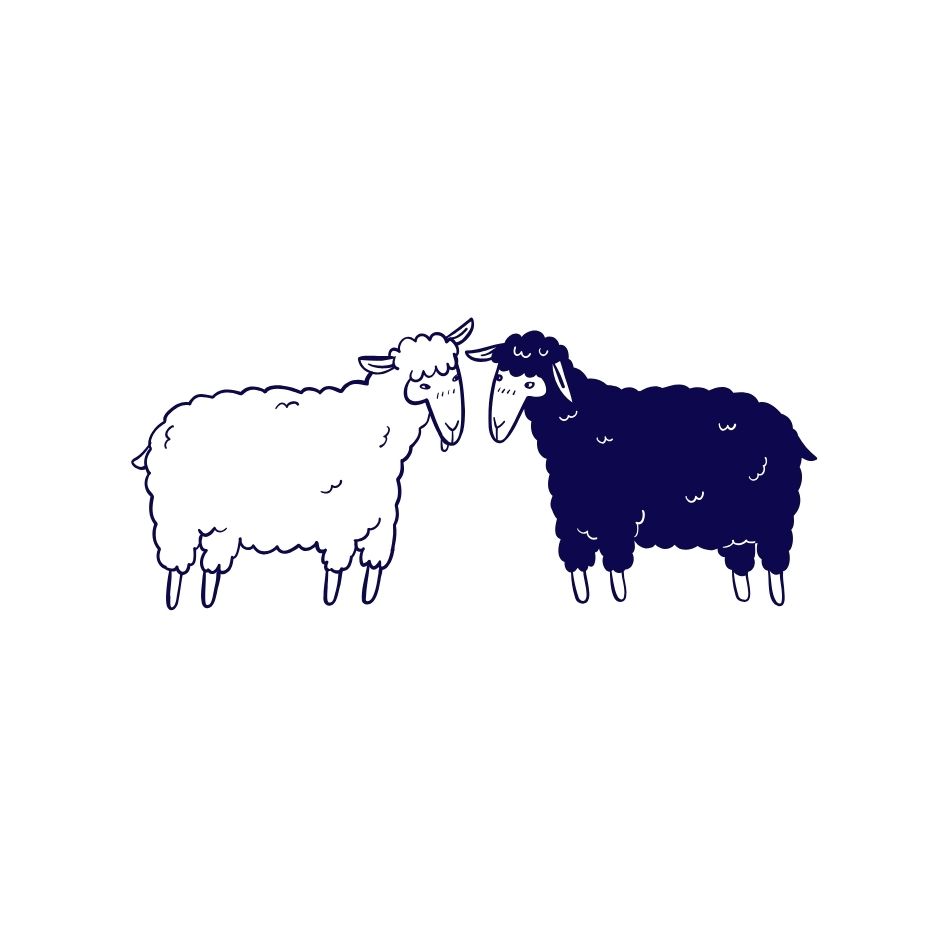
You can be the black sheep of the family and feel for years that you never really found your place there. Arrive at a family meal and already on the way feel your body contract. Weigh every sentence before you say it. Know who will roll their eyes, who will be offended, and who will once again remind you that something about you is too sensitive, too dramatic, or simply different.
The black sheep of the family is a family member who over time becomes a recurring focus of criticism, worry, blame, or a sense that they are different from the rest. From a systemic perspective, this role is created within family relationships and does not necessarily indicate that this person is the source of difficulty in the family.
When an experience like this repeats over years, it can gradually become an identity: “I’m the black sheep of the family.” “Something is always wrong with me.” “If only I were more like everyone else, I would have a place.”
The difficulty can continue even when we grow up, leave home, or distance ourselves from the family. You can be fifty years old and still turn within minutes into the girl explaining herself to her mother. You can choose a life completely different from what the family expected and still check through them whether your choices are right. You can also cut off contact and continue to conduct an internal daily argument with people who are no longer part of your life. I didn’t choose to be the black sheep of my family. In adulthood I can examine how much of my life I still organize around the place I was given there.
Families cope with tension in different ways. In some, the tension is distributed among family members and changes over time. In others, it gradually begins to organize around one person, especially when it’s hard to talk directly about conflict, difference, anger, shame, or uncertainty.
Within a complex family reality, a simpler explanation can form over time: “If only he would get along, there would be peace here.” “If she weren’t so sensitive, we wouldn’t fight.” “Everyone gets along in this family except her.”
Focusing on one person can temporarily ease the system. When everyone is busy with the child who gets into trouble, less attention is directed at the tension between the parents. When one sister is the one who always “makes drama,” the other family members can feel that they’re actually doing fine. When one person is seen as the one breaking up the family, it’s easier to focus on their behavior and less on what happened in the relationships before.
Murray Bowen’s family theory describes the Family Projection Process, in which family anxiety can focus on a particular child. The parents become more sensitive to signs that something is wrong with them, interpret their behavior through this worry, and respond accordingly. The child also reacts to the focus on them, and thus a self-reinforcing cycle is created. This is one way to understand how difficulty that belongs to an entire relationship system can over time appear to be located primarily in one person.
Such a pattern can establish itself more easily in a family where it’s very important that everyone agree, where deviation from the norm is experienced as a threat to cohesion, or where “what will people say” is very important. It can also develop around high parental anxiety, conflicts that are hard to talk about, or prolonged periods of family stress.
In families under stress for a long time, you can see different adaptation strategies. One becomes very responsible, another tries not to be a burden, and one person becomes the focus of worry, criticism, and anger. These are flexible roles that can change over the course of life, not fixed character traits.
There is no single answer. The place a person receives in the family can form from a combination of their temperament, the relationship that develops between them and their parents, the expectations directed at them, and the way they respond to tension. One child becomes quiet and adaptive. Another tries to be responsible for everyone. And there is a child who protests, gets angry, argues, or refuses.
The one who becomes the black sheep is not necessarily the weak one in the family and also not necessarily “the one who sees the truth.” Sometimes they are more different from the family norm. Sometimes they express distress in the most visible way. A particularly sensitive cycle can also form between them and one of the parents, or choices they make later in life unsettle something the family is used to.
Once a particular person becomes the focus, a cycle begins that is very easy to continue. The family expects them to be the one who will explode, distance themselves, or make trouble, and therefore becomes more sensitive to behaviors that confirm the expectation. They feel that they’re seen as the problem anyway, become more tense, defensive, explanatory, angry, or distant. Their response becomes, in the family’s eyes, further proof that the story about them is true.
“You can’t talk to you.”
“Because you never listen to me.”
“You see? That’s exactly what we’re talking about.”
Other family members can also participate in the pattern without meaning to. One parent criticizes and the other is silent. A brother joins the criticism. A sister understands privately but says nothing in front of the family. Gradually the role becomes part of the shared family story.
To understand the place I was given there, I want to broaden the view: what was happening in my family at that time? What was occupying it? What expectations were directed at me? And how did the relationships between us gradually shape the place I occupied within it?
Children learn who they are also through the gaze of the significant people around them. When the same message repeats for years, it can become part of the way we understand ourselves:
“You’re too sensitive.”
“You always make trouble.”
“You can’t talk to you.”
“You’re different from everyone.”
Over time, no one needs to say the sentence anymore. We start saying it to ourselves.
If they’re pleased with me, I’m okay. If they’re angry, maybe I did something wrong. If they see me as the problem, I need to convince them I’m not. This is how a sense of self can be built that is very dependent on the gaze that comes from outside.
Even the definition “I’m the black sheep” can become a rigid identity. It may give words to an experience that was confusing and painful for years, and later it’s worth asking who I am beyond this role. Replacing the label “I’m the problem” with the label “I’m the scapegoat of my family” still leaves a label at the center of identity.
The adult work invites a gradual building of a more stable sense of self: to know what I think, what I feel, what I stand for, and how I want to conduct myself even when a significant person sees things differently.
A partner’s criticism can feel like proof that we’re the problem again. A manager who disagrees with us triggers a need to prove she’s wrong. A friend who distances herself for a few days can evoke the old feeling that we’ve been left out again.
Within a relationship, the role can surface quickly. My partner says “I was hurt by what you said,” and I hear “You’re the problem again.” He doesn’t agree with me, and I feel like I’m standing alone again facing a whole family.
For those living without family support, an additional burden can form on the relationship. The partner becomes the central person, and sometimes the only one, from whom we expect to feel “you’re with me.” When they disagree with me, set a boundary, or see an event differently from me, the pain can be much greater than the disagreement happening now.
History helps us understand the intensity of the response. In adulthood, we can learn to recognize the moment when the present meets the old place, and gradually return to ourselves the choice in how we will respond.
The desire for family members to understand what happened, acknowledge the pain, and see us differently is human. The difficulty grows when my ability to be whole with myself depends on this actually happening.
I can spend years trying to prove to the family that I’m not selfish, not dramatic, and not the problematic child they thought I was. Even success can say “I’ll show them,” distance can say “I don’t need any of you,” and endless explanations can continue to ask “Finally understand who I really am.” This way the family gaze continues to organize life even from within the struggle against it.
For some people, this place becomes especially clear when they begin to set boundaries, attend fewer family gatherings, choose differently, or stop participating in conversations that hurt them. The change itself can be read through the old story: “You’ve changed since you met him.” “You’re destroying the family.” “Only with you there are always problems.”
For some people living today without family support, the distance from the family of origin came after years in which it was hard to find a place within it without giving up significant parts of themselves. Within this story, it’s also important to look at the way we act today. You can set a boundary from a clear position, and you can use distance to punish. You can bear the family’s disagreement, and you can continue to demand that they acknowledge that we’re right.
When the family invites me back to the familiar place, I want to notice my response. Am I returning to explain, defend, distance myself, or fight for them to see me differently? Can I choose a different response even when they remain exactly as they are?
I also wrote about this movement in the article “What can happen when we stop waiting for our parents to change?”.
The family we came from is part of our life story even when the relationship with it is complex. It can remain significant even when we live differently from it, choose distance, or decide not to be in contact.
You can live very far away and still make decisions out of fear of the family’s reaction. You can not speak to your parents for years and still conduct an internal argument with them in every significant choice. And you can be in contact and know very well where they end and where I begin.
I’m interested in how much of my self still depends on family members understanding me, agreeing with me, or thinking of me differently. I can acknowledge the place I came from, the pain that was in it, and what I received from it, and choose how I want to live today.
I wrote more about this movement in the article “How to be true to yourself even when you grew up without supportive family backing.”
In my view, this is one of the most important questions in working with those who grew up as the black sheep. If every criticism immediately returns me to the position of the child who is always blamed, I am still meeting the present through the old role. The need to reject all criticism to protect myself also keeps me tied to it.
It may be that the criticism I received in childhood was harsh, unfair, or humiliating, and yet a person criticizing me today may see something I should check. It may also be that they are completely wrong. I want to be able to clarify this.
What of the things said to me belongs to the person in front of me?
What activates something old in me?
What of the things said do I want to take seriously?
This is one of the capacities we develop in working with differentiation in the clinic: to stay connected to ourselves even when a significant person thinks something about us that is hard for us to hear. I can agree with part of their words, disagree with another part, and take responsibility for what belongs to me. The fact that I was labeled in the past does not exempt me from responsibility for the way I conduct myself today.
Work on differentiation strengthens the ability to stay connected to myself in the presence of a person who thinks, feels, or wants something different from me. Integrity adds to this the way I choose to conduct myself: Can I take responsibility when I’ve hurt someone? Apologize without falling apart? Set a boundary without humiliating? Speak truth even when it’s uncomfortable to say it? Stand behind my choice even when someone else is disappointed by it?
The distinction between guilt and responsibility is especially important for those who grew up feeling they were always the problem. Guilt returns me to “Something is wrong with me again.” Responsibility allows me to ask: “What of what happened belongs to me, and what do I want to do with it now?”
As children we were not responsible for the place we received in the family, for the way our parents coped with tension, or for the stories created around us. In adulthood, our responsibility lies in the way we act when the old place is triggered. I can see myself and the person in front of me, bear disagreement, and choose behavior I can respect.
A family gathering can trigger a response before anything explicit is said. A look, a familiar tone, or silence can be enough. Breathing shortens, the jaw tightens, the stomach contracts, and attention immediately shifts to the others.
When I recognize this moment, a small space can form between what I feel and what I do. Within the space, I can ask: “What position do I want to hold here, and how do I want to behave from it?” This way the hurt is given a place without deciding for me what I will do next.
A woman in her forties came to me with a feeling that she had always been the outlier in the family. From childhood they described her as someone who exaggerates, is sensitive, and makes drama. Even in her adulthood, a family gathering quickly returned her to that same place.
At the beginning of the work, we gave space to her story, and later we broadened the view to the system in which it was created. What was happening at home during the periods when she became “the problematic child”? What happened between family members when she resisted? And what became possible for others when attention was directed at her?
Then we began to be interested in what happens today. She discovered that the moment she feels misunderstood, she enters a struggle for recognition: explains, brings more examples, and tries to make the person in front of her understand why they are wrong about her. When recognition doesn’t come, she closes up and distances herself.
We asked: “What is important for you to hold in yourself at the moment when a significant person still doesn’t understand you, and how do you want to act from there?” Gradually the center of gravity shifted from the struggle over the family story to her ability to choose how she wants to conduct herself today.
Choose a family sentence that triggers you even today. For example: “You’re too sensitive.” “You always make trouble.” “You can’t talk to you.”
Read it once and notice what happens in the body. If a strong response comes up, stop, look around you, and feel your feet on the floor or the support of the chair.
Now ask yourself:
The goal is to expand the ability to feel what arises, check ourselves honestly, and choose our behavior.
The release begins with broadening the story. To understand how the role was created, to see the tension that was in the family and the place we occupied within it. We can give weight to what happened to us, be angry, grieve what we didn’t receive, set boundaries, and choose distance when it’s right for us.
Later comes the examination of our life today: what happens to me when the family continues to see me through the old role? Where am I still explaining, proving, fighting, or distancing in response to their gaze? How do I want to conduct myself even when they don’t change?
I can know what I went through without needing them to confirm my story. I can listen to criticism without turning it into a verdict. Take responsibility for a mistake without returning to the identity of the problematic child. Set a boundary and bear the possibility that someone will be angry about it. I can also live without family support without asking my partner to become the person who must always stand by my side so I know I’m okay.
Who I am today I learn to know also from the way I choose to live, and not only from the way others choose to see me.
The family can continue to hold the old story about me. I no longer have to live within it.

+
For people without a supportive family network.
We will reveal how the lack of a family network challenges and strengthens the couple's relationship, the high prices it exacts from you and your relationship.
Couples therapy will strengthen your sense of security and belonging, so you can be close without losing yourselves along the way.
Online / In-person clinic

+
Individual therapy is a safe space where you will rediscover your strengths, build inner confidence, and create a whole and meaningful life for yourself, just as you dream.
Online / In-person clinic
+
You are invited to enter a unique space: an interactive conversation with special GPTs I created – a first-of-its-kind tool that looks inward with you in the language and frequency of the systemic constellation.
If there is something unresolved in your relationship, family, or heart – the chat will gently meet you without trying to fix it, inviting a different, slow, precise, and quiet perspective. There is no need to understand, just to see and let it work.
Expert in couples therapy for relationships without a supportive family safety net.
Developer of the Couples Constellation approach: a systemic-emotional therapy that brings the couple’s relational dynamics into contact with unspoken family patterns, alongside practical tools that enable movement, connection, and the creation of a deep partnership.








Let’s start with a brief introductory call, free of charge and commitment.
Sometimes, this small step changes everything.
The sessions take place
online via Zoom / face-to-face in Tivon, according to your choice