Home / Who Taught You That’s What Love Looks Like? 7 Sentences That Can Transform Your Relationship
Most of us learned what love looks like long before we fell in love for the first time. We learned it at home, from the way our parents loved, fought, made peace, stayed silent, cared, distanced, and drew close. We also learned it from the place we had within the family.
Perhaps we learned that love means taking care of everyone. That a loving person gives up. That when someone we love is sad, we need to make them feel better. That to maintain a relationship it’s sometimes better to stay quiet. That if someone is angry with us, we should hurry to fix it. Perhaps we learned that love means knowing what the other person needs even before they ask.
We grow up, fall in love, choose a partner, and build a home together. Within this new story, the things we once learned about love continue to live. Some of them are beautiful and serve us well to this day. Others were very wise ways to maintain connection and belonging within the family we grew up in, and today they exact a price from us.
Sometimes this price appears precisely where we most want to love.
We give a lot and begin to expect the other person to understand how much we’ve given. We give up and hope they’ll choose us in return. We worry about our partner, and within that worry an expectation begins to creep in that they’ll be calm so we can be calm too.
This is how a transaction can form in a relationship that neither of us put into words:
I’ll take care of you, and you’ll make sure I feel needed.
I’ll give up, and you’ll know to appreciate me.
I’ll keep the peace, and you’ll maintain the connection.
I’ll rescue you, and you won’t leave me.
These are hidden contracts. In most cases they’re born from a deep longing for closeness, security, and love. When we begin to recognize them, the possibility opens to create a relationship with more freedom between us.
Imagine a couple who comes to see me at the clinic. Let’s call them Yael and Uri.
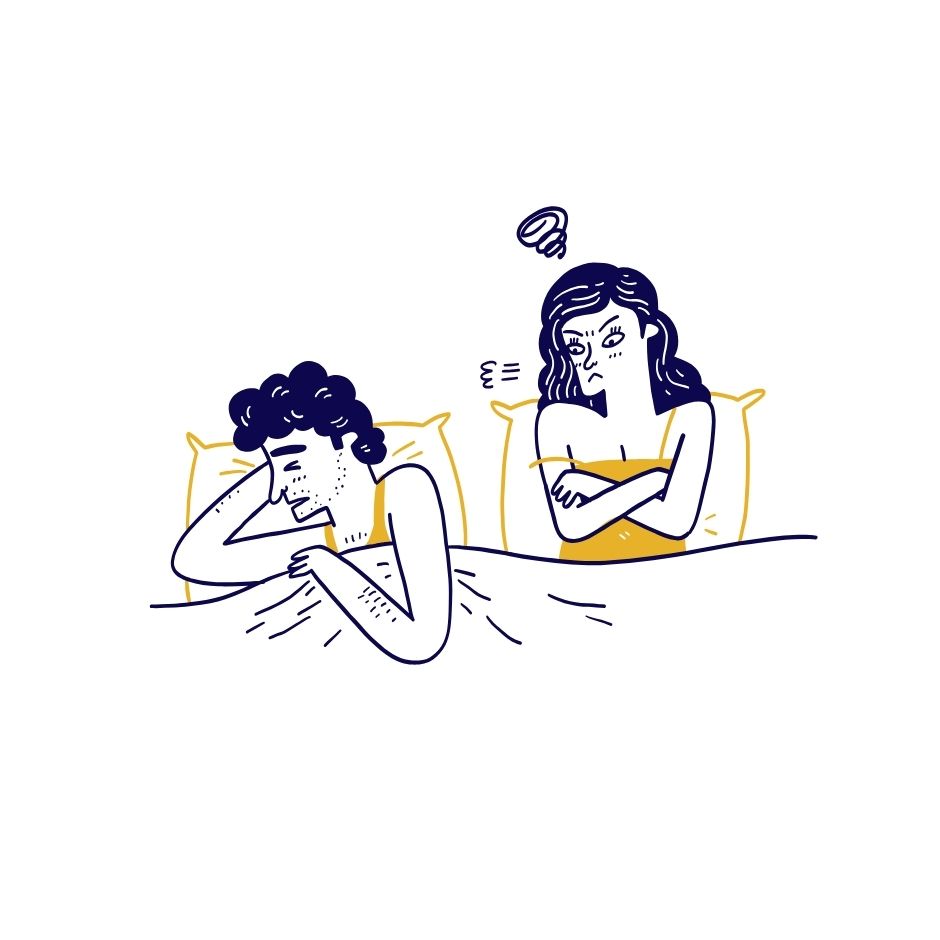
Uri is going through a difficult time at work. He comes home tense, talks less, sleeps less well, and sometimes becomes short-tempered. Yael senses it from the moment he walks through the door.
Did something happen?
No.
Are you sure?
Yes.
Was there something at work?
Yael sees that something is affecting him. She suggests he talk to his boss. Maybe he should start looking at other jobs. Maybe cancel the weekend plans so he can rest.
Leave me alone for a moment, he says.
Yael is hurt.
I’m just trying to help you.
By evening she’s already angry. She does everything to make things easier for him and he won’t even talk to her. Uri withdraws even more.
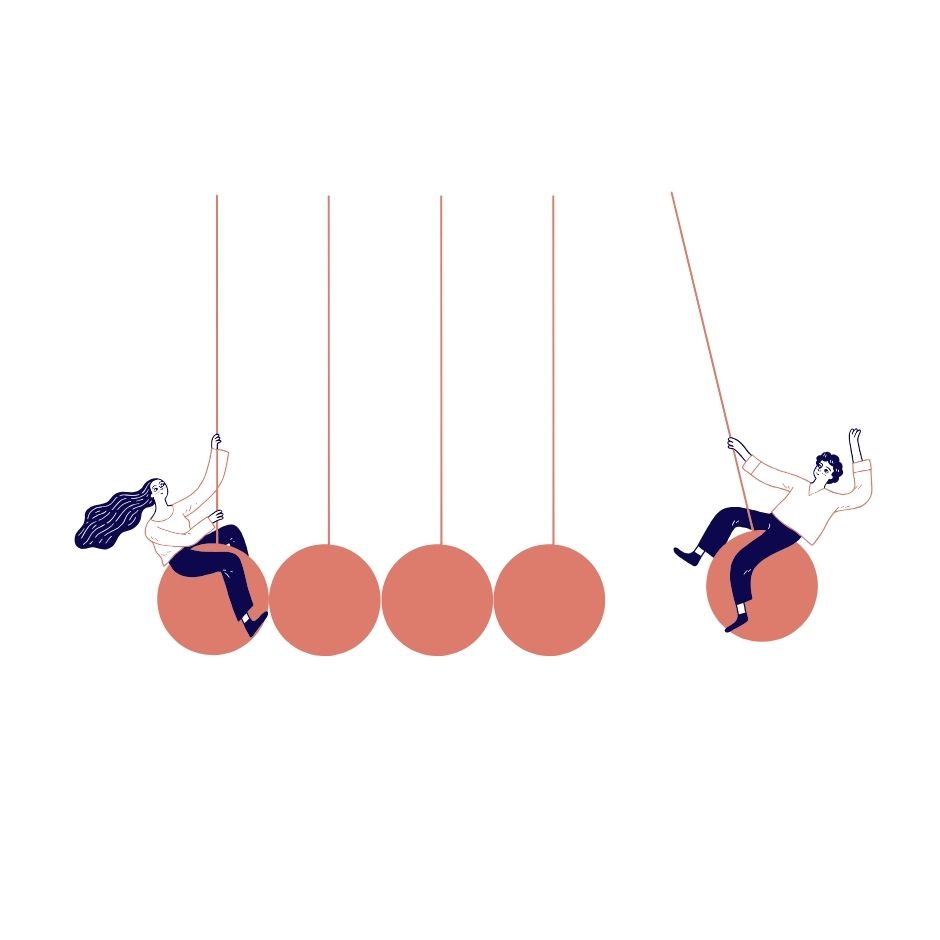
It’s hard for Yael to see Uri distance himself. His distance stirs unease in her, and as the unease grows she tries to get closer. She asks, suggests, checks, and tries to solve. Uri feels he needs more space and distances himself. His distance increases her unease, and her attempt to get closer increases his need to distance.
This is no longer just a conversation about a difficult day at work. A couple’s cycle has formed between them.
In therapy I’m interested in understanding this cycle. What does Yael feel the moment she sees Uri walk in with a closed expression? What happens in her body? What is she afraid of if she lets him be in his mood for a moment? What does Uri feel when she asks for the third time what happened? What is he asking for himself when he withdraws?
I’m interested in another question: What does Yael hope to receive from Uri through all the help she offers him?
Perhaps she truly wants to make things easier for him, and at the same time, perhaps there’s also a hope within her that if she succeeds in helping him he’ll become available to her again. That he’ll smile, that he’ll talk, that he’ll tell her he needs her.
Sometimes we give out of love and also ask for something through that giving. The problem begins when the request remains hidden.
Yael has known sensitivity to others’ moods long before she met Uri. As a child she could already tell from footsteps in the hallway what mood her mother was in. She knew when it was good to talk and when it was better to be quiet, when to be an especially good girl, when not to ask, when to help, and when to take up a little less space.
Her body learned to recognize. Her nervous system learned to prepare. Within the family she found a way to maintain connection, belonging, and security.
Years have passed and Yael has grown up. Today she sits across from Uri, and her body still recognizes a change in the mood of someone she loves as something that requires her attention and action.
I encounter this often in couples therapy:
The child who was responsible at home sometimes becomes the responsible partner.
She who learned to keep the peace continues to make sure no one is angry.
He who had to be strong struggles to let his partner see him in need.
He who learned his needs were a burden on others can become an adult who struggles to ask directly for what he needs.
From a family constellation perspective, behind each partner stands an entire system. Parents, grandparents, losses, relationships, roles, loyalties, and the ways the family learned to love, belong, and survive.
Sometimes we continue to perform within the relationship a role that belongs to the family we grew up in. The girl who took care of everyone continues to take care of everyone. The child who had to manage alone struggles to lean on others. The one who kept peace at home continues to be responsible for making sure no one is angry.
The relationship is one of the places where these patterns are awakened with intensity. It can also become the place where we see them and begin to choose how we want to live and love today.
“I don’t need to rescue you.”
This is a sentence that evokes many reactions. Try saying it to yourself and notice what happens.
Perhaps the thought immediately arises: but if I don’t help them, who will?
Perhaps a tightening appears in your stomach.
Perhaps you remember a moment when your partner truly needed you.
Rescuing and loving are two different movements.
When I love you, I can see that things are hard for you, take interest, draw close, offer help, and be with you.
When I feel I must rescue you, your difficulty begins to manage me too.
Rescuing has another layer that’s harder to admit. When I rescue you, I’m also influencing what you’ll do, how you’ll feel, and how the situation will develop. If I succeed in making you calm down, I can calm down too. If I succeed in solving the problem for you, perhaps I’ll feel I have control again.
Even loving giving can become this way an attempt to manage reality.
Differentiation allows me to stay close to you and remember that we are two people. I can be affected by what you’re going through and recognize that you have your own strengths, choices, and responsibility.
I see you. I recognize your strengths. I trust your ability to carry your own life. I can hold your hand along the way and leave you the space to walk it yourself.
When I release myself from the role of rescuer, I also release you from the role of someone who needs rescuing.
I see a lot of respect in this kind of love.
There are moments when our partner is angry with us, disappointed in us, or simply sees things differently. Sometimes beneath an argument about dishes in the sink, money, the children, or Friday dinner, much deeper questions arise:
Do you still love me?
Am I still important to you?
Am I still worthy?
Are we okay?
Someone who learned that connection is maintained through pleasing, adapting, or giving up may feel an intense need to quickly restore peace. She may agree before checking what she really thinks, give up a boundary that was important to her, or apologize quickly to feel the connection is secure again.
Sometimes a hidden contract forms here too:
I’ll adapt myself to you, and in return you won’t be angry with me.
I’ll give up what’s important to me, and you’ll continue to choose me.
The difficulty is that after years of such a contract we may become angry with our partner for a price we ourselves pay to maintain the love.
“I stay with myself even when you’re not pleased with me.”
Worthiness for me is knowing that my value stays with me even when another person is not pleased with me.
Worthiness also asks me for integrity. I listen to you and truly ask myself if there’s something in my behavior I want to take responsibility for. If I hurt you, I can make amends. If I recognize I acted from fear, manipulation, criticism, or an attempt to control, I can meet that too.
I want to be a person I can respect within this relationship.
The question isn’t only what I deserve from my partner. The question is also what kind of partner I want to be.
I can remain true to myself and at the same time agree to see the places where I want to grow.
A mature relationship needs enough space for two people. Two desires. Two experiences. Sometimes also two different truths, and also two people willing to look honestly at themselves.
When someone we love is suffering, a desire awakens in us to ease their burden. When they’re sad we encourage. When she’s afraid we reassure. When he’s hurt we explain. When she despairs we look for a solution.
Sometimes what a person needs is simply our presence.
“I see your pain, and leave it with you with respect.”
I love the word “respect” in this sentence. It changes the entire meaning. I leave the pain with you because I recognize that it’s yours. It has its own story, rhythm, and movement. I trust your ability to meet it.
When I say this sentence, I feel there’s also a physical movement in it. Something stops. The breath expands. The hands no longer rush to do. It’s possible to listen.
I see that it hurts you.
Your pain matters to me.
I stay beside you.
This is one of the deepest forms of intimacy: the ability to be with a person where it hurts and allow them to be exactly where they are.
There’s also trust in this. Trust that the person I love is big enough to meet their own life.
We come to a relationship with what we received and with what was missing. With who saw us and with who was busy with their own pain. With the places where we felt protected and with the places where we learned to manage alone.
Within the relationship ancient longings awaken:
that they’ll see me,
that they’ll choose me,
that they’ll stay,
that they’ll protect me,
that they’ll love me the way I always wanted to be loved.
These are deep human longings. When we manage to recognize them, we can also see what request we sometimes place on our partner’s shoulders.
To be the father who wasn’t there.
To be the mother who didn’t see.
To be the family that didn’t hold.
To prove to us again and again that we’re worthy of love.
Here too a hidden couple’s contract develops:
If you really love me, you should know what I need.
If you really love me, you shouldn’t leave me alone with this pain.
If you’re really my partner, you should give me everything I didn’t receive.
A partner can be loving, attentive, generous, and very present, and still not succeed in filling the void created years before they met us.
“You are my partner. I release you from the need to be the parent I was missing.”
This is one of the most painful and healing sentences in my view. There’s sadness in it about things we didn’t receive at a time when we needed them. And when we give this pain a place as part of our story, something is also released within the relationship.
I can see what you give.
I can see your limitations.
I can see you as a person in your own right.
And you can be my partner. The person with whom I create something new.
When couples tell me about their difficulty, I listen to the cycle that forms between them.
He withdraws and she moves closer. She criticizes and he distances.
He stays silent and she raises her voice to reach him.
Each response becomes part of the other’s experience and invites the next response.
One of the most important questions I invite each partner to ask is what’s mine in this cycle?
What happens to me when he distances?
What do I do when I’m afraid?
How do I speak when I feel unseen?
What boundary is important for me to set?
What did I want to ask and didn’t?
What do I do when I feel helpless?
And what do I continue to attribute to my partner even though I have an active part in creating it?
“What belongs to me, I take.”
My words, my fear, my anger, my boundaries, my requests, and my choices.
Also the places where I act in ways I’m not proud of.
Also the silences in which I expected you to understand on your own.
Also the times I gave in order to accumulate credit to receive.
Also the moments when I used my vulnerability to make you change.
Taking responsibility isn’t a sentence that diminishes me. It returns power to me, because the moment I see my part, I can also choose something else.
The complementary movement is: “What belongs to you, I leave with you.”
Your choices, your relationships with your parents, the way you cope with work, your ability to ask for help, your responsibility for your words and actions, and your way of developing.
I can tell you what I need.
I can ask.
I can set a boundary.
I can decide what I’ll do in response to your choices.
This creates a relationship where each person takes responsibility for their part and stops managing the other’s part.
In my view, that’s precisely where real freedom within a relationship begins.
Many people I meet learned that love involves giving up. To be loved, I should adapt myself. To have peace, I’ll give up. To maintain the connection, I’ll take care of others first.
Giving is a beautiful and important part of love.
The question that interests me is from what place am I giving. Sometimes a person sits across from me and says: “I gave so much. How did we get here?” I invite them to look at that giving with curiosity.
What did I give from choice and love?
What did I give from fear of losing?
What did I want to give?
What did I hope to receive in return?
Did my partner know I was expecting something in return?
Where was I in all this giving?
Prolonged self-sacrifice can create an emotional debt that no one but us knows they’re supposed to pay. I give up again and again, and within me an expectation is recorded—one day you’ll see how much I gave. One day you’ll appreciate. One day you’ll give back to me. When that day doesn’t come, love begins to mix with bitterness.
“I can love you without giving up myself.”
For me this is a sentence that connects love and worthiness. I’m worthy of being in a relationship even when I have desires. I’m worthy of asking, setting a boundary, saying no, taking up space, and being a separate person within a couple.
At the same time, I want to check myself. Am I clearly asking for what I want?
Am I willing to hear no as well?
Am I giving my partner the same separateness I’m asking for myself?
Am I behaving within the relationship in a way that fits the person I want to be?
Worthiness isn’t only knowing I deserve, worthiness is also building within me a person I trust.
This sentence holds all the others within it—“I choose us without leaving myself.”
I want this relationship. I want to be close to you, to know you and be known by you. I want us to be able to lean on each other, share life, raise a family, grow together, and feel we have a home within the relationship.
And within all this I want to remain myself too.
With my desires.
With my boundaries.
With my responsibility.
With my body.
With my story.
With the possibility of thinking differently from you and staying close to you.
Choosing us for me also means asking what part I have in the quality of the relationship I’m asking to create.
If I want honesty, am I speaking honestly?
If I want closeness, am I willing to be seen?
If I want my boundaries respected, do I respect the other’s boundaries?
If I want responsibility taken, am I willing to take my responsibility?
If I’m asking for a worthy relationship, what kind of partner am I choosing to be within it?
This for me is a differentiated relationship. Two people who can be very close, and within that closeness each continues to be a whole person.
Two people who agree to meet themselves within the relationship too.
Two people who can choose each other from greater freedom and less from fear.
Perhaps one of the beautiful things about relationships is that precisely when we stop demanding the other be responsible for our wholeness, more space opens for intimacy.
I want to offer you a small exercise. The first time it’s good to do it alone.
Read again, slowly, the seven sentences:
Notice the sentence your body reacts to most strongly. Perhaps your breathing changes. Perhaps a tightening appears. Perhaps sadness arises. Perhaps a thought immediately comes up that wants to argue.
Stay with that sentence a little longer.
Say it again, slowly.
Notice where you feel it in your body.
If it feels right, you can place a hand on that place.
Ask:
What frightens me about this sentence?
What am I afraid will happen if I live this way within my relationship?
What do I gain from the role I’m filling today?
What do I expect my partner to give me in return?
Does he even know we have such a contract?
What is this sentence asking me to take back to myself?
Then you can turn your gaze to the family you came from.
Where did I learn that’s what love looks like?
Who in my family was responsible for everyone?
Who had to be strong?
Who gave up themselves to maintain the connection?
Who took care of peace at home?
Who took care of whom?
Who rescued whom?
Who had to be okay so the others could be okay too?
Which of these roles is familiar to me today?
Give your body time.
Sometimes it knows something we don’t yet have words for.
If you’ve come this far, I want to return with you to the question we began with—who taught you that’s what love looks like?
Perhaps you grew up in a home where love meant worrying.
Perhaps for you love meant giving up. Perhaps love meant being strong and not being a burden.
Perhaps you learned that people who love stay together at any cost.
Perhaps love meant knowing what the other needs without them having to ask.
And perhaps you also received from home generous, stable, secure love that you continue to pass forward.
All of these live within us.
When we begin to see how we learned to love, it becomes possible for us to ask—how do I want to love today?
How do I want to be with you when things are hard for you?
How do I want to stay with myself when you’re angry?
What responsibility am I willing to take within our relationship?
What responsibility am I willing to leave in your hands?
Am I asking you directly for what I want, or giving and hoping you’ll understand?
Am I choosing you, or do I need you to behave a certain way so I can feel secure?
What kind of partner do I want to be?
What kind of partner do I want to be?
What kind of love do we want to pass forward to our children?
These are precious moments in my view. Moments when something that was automatic for years becomes visible, and within what becomes visible a possibility for choice opens. I can take to myself what belongs to me and leave with you with respect what belongs to you.
I can meet you as a whole person, and come to that meeting as a whole person myself. You are my partner. I am your partner. Each of us has a whole story, a whole family, a body that remembers, needs, fears, strengths, and a longing to be loved.
And we also have the ability to choose:
to choose how we’ll speak,
how we’ll take responsibility,
how we’ll ask,
how we’ll love,
what people we’ll be within this relationship, and what relationship we’ll create together.
Change in a relationship can begin with a big conversation or a small moment when we recognize an old movement and choose to do something slightly different. Change can also begin with one sentence: I choose us, without leaving myself.

+
For people without a supportive family network.
We will reveal how the lack of a family network challenges and strengthens the couple's relationship, the high prices it exacts from you and your relationship.
Couples therapy will strengthen your sense of security and belonging, so you can be close without losing yourselves along the way.
Online / In-person clinic

+
Individual therapy is a safe space where you will rediscover your strengths, build inner confidence, and create a whole and meaningful life for yourself, just as you dream.
Online / In-person clinic
+
You are invited to enter a unique space: an interactive conversation with special GPTs I created – a first-of-its-kind tool that looks inward with you in the language and frequency of the systemic constellation.
If there is something unresolved in your relationship, family, or heart – the chat will gently meet you without trying to fix it, inviting a different, slow, precise, and quiet perspective. There is no need to understand, just to see and let it work.
Expert in couples therapy for relationships without a supportive family safety net.
Developer of the Couples Constellation approach: a systemic-emotional therapy that brings the couple’s relational dynamics into contact with unspoken family patterns, alongside practical tools that enable movement, connection, and the creation of a deep partnership.



Let’s start with a brief introductory call, free of charge and commitment.
Sometimes, this small step changes everything.
The sessions take place
online via Zoom / face-to-face in Tivon, according to your choice