What did we learn at home about forgiveness, guilt, and repair?
I don’t remember the first time I asked for forgiveness from someone I truly loved. I do remember clearly that I didn’t know how to do it, because in the home where I grew up there were no conversations of repair. There were silences.
My mother’s silences were not quiet. They were punishment in *”I’m not speaking to you.”* As a child I felt them as excommunication. When I was offended, cried, or dared to rebel, one thing was required of me: to ask for forgiveness.
It was a one-way movement. The child asks forgiveness from her parents. The parents, the adults, did not ask forgiveness from us, the children. This created in me a child’s understanding: the adult does not ask forgiveness from the small one. Whoever asks for forgiveness is the one who lost.
It took me years to understand there is another possibility.
From a constellations perspective, there is meaning in the place from which we learned what happens after hurt. A child depends on their parents and belongs to the system into which they were born. Within these relationships there is asymmetry from the start: the parents came first, and the child depends on them. A relationship is built differently. Both partners are adults, equal in worth, and each is responsible for their behavior within the relationship.
When I bring into the relationship the logic I learned as a child, asking for forgiveness can continue to feel like a loss of status: one is right and one is wrong, one is big and one is small, one wins and one loses. It’s worth checking whether in moments of hurt we’re still meeting each other as partners, or whether the movement between us is starting to resemble an older relationship system.
We bring into the relationship the emotional language of the family we came from as well: the ways they got angry, fell silent, punished, reconciled, or carried on as if nothing had happened. We carry with us what we saw happen after hurt and also what we never saw.
Understanding where I learned my pattern can bring context and compassion. From the moment I see it, the responsibility for what I do with it today is mine.
When I say “forgive me,” what am I actually asking of you?
Let’s say I hurt my partner. I said something cruel during a fight, broke a promise, ignored something that was important to him, hid something from him, or repeated behavior I already know hurts him.
Now I see his hurt and inside me rise guilt, shame, and fear. Perhaps I’m afraid he’ll distance himself from me. Perhaps it’s hard for me to meet myself as someone who hurt someone they love. I want this feeling to stop, and then I say: “Forgive me.”
It’s worth stopping there for a moment and asking honestly: For whose sake is this request for forgiveness being said right now?
“Forgive me” can carry within it a request: “Tell me I’m still okay.” It can ask: “Show me you still love me.” It can express a wish that we return already to the place where things are comfortable between us. It can also become, without my intending it, a request for you to help me stop feeling guilty.
From a differentiation perspective, this is an important point. Am I able to stay with you when your experience of me right now is not the experience I would want you to have? Can I bear the fact that you’re hurt or angry at me without immediately trying to change your feeling so I can feel safe in the relationship again?
Asking for forgiveness can be a movement of closeness and responsibility. When it turns the person who was hurt into the one responsible for easing the discomfort of the person who hurt them, something in this movement shifts.
Guilt can lead to responsibility. Shame turns me back to myself
There is an important difference between the ability to feel guilt and sinking into shame.
Guilt can direct me toward the act: I did something that hurt you. It can tell me I behaved in a way that doesn’t align with my values and motivate me to take responsibility and repair.
Shame turns the gaze toward my identity: If I did such a thing, something in me must be wrong. When I’m pulled into shame, I become very occupied with myself. I may shrink, defend, explain, attack back, or need my partner to tell me I’m still good and worthy.
It’s precisely the ability to remain worthy that allows me to bear the knowledge that I made a mistake without falling apart from it. I can be a worthy person who did an act that hurt another person. My worth is not erased because of my mistake, and therefore I don’t need you to restore it to me.
Differentiation adds another movement here: I can hold my experience and your experience simultaneously. I know who I am, and you are allowed to be hurt by me. I can know I didn’t intend to hurt, and give space to the fact that this was the impact of my behavior on you.
The less occupied I am with defending my worth, the more room opens in me to see you.
How can “forgive me” transfer responsibility to the person who was hurt?
I’m the one who hurt you, and then I asked for forgiveness. From here the center of gravity can shift to the question: “Do you forgive me?”
If you forgave, we can supposedly move forward. If you’re not yet ready to forgive, sentences like “I already asked for forgiveness,” “How much longer will you be angry at me?” or “What else do you want me to do?” arrive easily.
At this moment the conversation is almost no longer about what I did and what my action did to you. It starts to be about your difficulty forgiving me.
In my work with couples I meet this movement again and again. One partner says in pain: “I apologized. I asked for forgiveness. What else can I do?” When we stay a bit longer with this sentence, sometimes another difficulty is revealed: “I can no longer bear that you’re still hurt by me.”
From here another movement can begin: “I see you’re still hurt. It’s hard for me to meet that, and I want to stay here and listen.”
There is something deep in this sentence from a differentiation standpoint: I don’t need you to change your experience so I can stay in relationship with you. I can bear the tension between my desire for closeness and your pace.
An apology that recognizes the hurt starts with what I did
There’s a difference between saying: “I’m sorry you were hurt.” and: “I’m sorry for what I did and for the hurt it caused you.” In the first sentence the center of gravity is in your experience: you were hurt. In the second sentence I bring into the picture my behavior as well and the connection between it and your pain.
Intention matters. The impact of my behavior also matters. I can say I didn’t intend to hurt and still recognize that I did hurt.
Taking responsibility doesn’t require me to agree with every interpretation you have of me or my intentions. It asks me to be able to look at what I did and at the impact it had on you.
This is a significant distinction in differentiation: I can take responsibility for my behavior without taking responsibility for everything you think, feel, or conclude as a result. By the same measure, I cannot use differentiation to disavow the impact my behavior had on you.
Repair needs to be connected to the hurt
Hurt in a relationship changes something in the space between partners as well. Perhaps trust was damaged. Perhaps the sense of safety was hurt. Perhaps respect, intimacy, or the knowledge that we can lean on each other took a blow. Therefore a word of forgiveness alone doesn’t necessarily restore what was damaged.
If I hurt your trust, my repair needs to be connected to trust.
If I humiliated you, I need to examine how I restore respect to the space between us.
If I was absent from you again and again in moments when you needed me, the question is how I begin to be present differently.
Repair needs to be connected to the hurt. Asking for forgiveness can open the door. What happens after it will determine whether something in the relationship can actually change.
From a systemic perspective, repair also restores order to responsibility: what belongs to me returns to me. I stop asking you to carry my guilt, and you are not required to give up your pain in order to restore peace to the system.
Differentiation: can I remain even when they’re still angry at me?
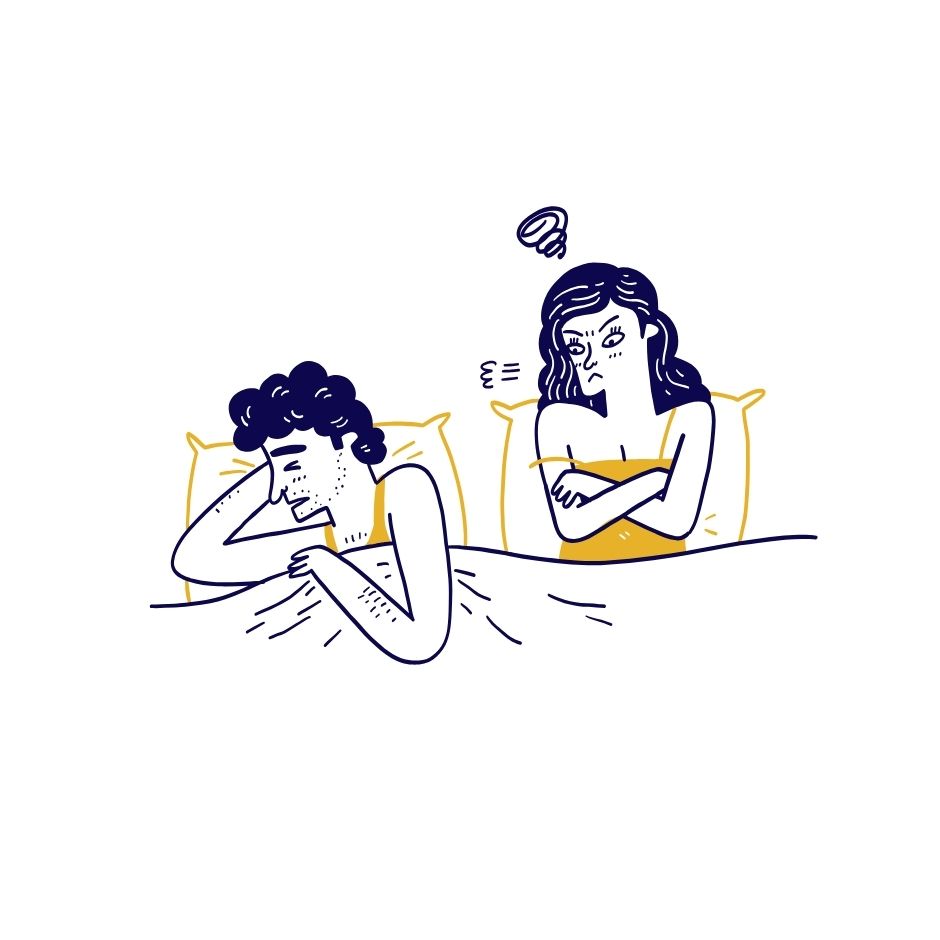
One of the deepest tests of differentiation in a relationship comes precisely after we’ve hurt each other. I tell you I’m sorry, and you’re still angry. Maybe you don’t want to get close to me right now. Maybe you need more time. Maybe my apology isn’t enough for you.
- Am I able to bear the possibility that you’re disappointed in me without rushing to convince you I’m a good person?
- Can I listen to your pain without defending myself?
- Can I allow you your pace without turning the time you need into punishment you’re imposing on me?
This is differentiated responsibility-taking. I remain connected to myself while at the same time staying in contact with the impact my action had on you.
There’s another difficult part here: agreeing that I have no control over the outcome of the repair. I can take responsibility, apologize sincerely, listen and change my behavior, and my partner may still need time. Trust can return slowly. Hurt can have consequences I didn’t want.
Taking responsibility is not currency I use to buy back closeness—I can take responsibility for what I did without getting the outcome I want in return.
What is the responsibility of the person who was hurt?
The person who was hurt also has a full place within the process. They are worthy of their time and their pain. They are not required to forgive in order to reassure the person who hurt them and are not obligated to return to closeness before they’re ready.
They too remain a person with choice and responsibility. They are responsible for how they express the hurt and for the choices they make in its wake. Forgiveness, if it comes, can be their choice. A boundary, distance, or a request for change can also be their choice.
Differentiation allows us to hold asymmetry here without turning it into a struggle over who’s good and who’s bad. In a particular incident one of us can be the one who hurt and the other the one who was hurt, and still we both remain equal-worth partners.
Responsibility for the hurt is not automatically divided between the two partners. Responsibility for the act belongs to the one who did it. Responsibility for myself belongs to each of us. When we struggle to hold this distinction, we can find ourselves moving between blame, victimhood, and attempts to rescue or fix the other. I expanded on this movement in the article about the drama triangle in relationships.
This way it’s possible to remain two people of equal worth even when responsibility for a particular event is not equal.
Forgiveness, responsibility, and repair are three different movements
Forgiveness is in the hands of the person who was hurt. I cannot determine whether they will forgive me, when they will forgive me, and what forgiveness will look like for them.
Responsibility for my act is with me. I can recognize what I did, listen to what it did to you, examine what led me to act as I did, and consider what I need to do differently so this pattern doesn’t continue to run me and our relationship.
Repair is a movement created between us. I can offer repair, but I cannot force it. You can choose whether and how to meet it.
From a constellations perspective there’s a simple and important movement here: each holds what belongs to them. I hold responsibility for my act. You hold your experience and your choice regarding forgiveness. Neither of us needs to take from the other what belongs to them in order for the relationship to continue.
Your forgiveness belongs to you. My responsibility belongs to me. Repair, if it becomes possible, is created between us.
What can we say after we’ve hurt someone?
We can start with clear recognition: “I see that I hurt you.”
Then take responsibility: “I’m sorry for what I did and for the hurt it caused you.”
You might add: “I want to understand better what this hurt did to you and explore what I need to learn and change.”
And then: “I’m willing to do my part in repairing this.”
Not every apology needs to sound exactly like this. These are not magic sentences. The importance lies in the stance from which they’re said: I see you, I see my behavior, and I’m willing to carry the part that belongs to me.
Another way to work with phrases of forgiveness, responsibility, and closeness within conflict is practicing Ho’oponopono in your relationship and the four phrases it offers.