Home / You’ve learned to listen to everyone, but what do you want?
You know what you want, and then you start explaining to yourself why it’s not really that important. You’re about to say “no,” and you already hear yourself saying “okay.” You want to ask for something, and before the request gets words you’re already thinking how it will affect the person in front of you. You make a decision that fits you, and an hour later you start doubting it because someone else didn’t like it.
From the outside these may look like small decisions. Inside something more significant is happening: you know something about yourself, and you struggle to stay loyal to that knowing when someone else wants something different. Your desire still exists, and yet the other’s desire starts taking up more and more space.
If you grew up in a family where belonging was tied to adjusting to others, loyalty to yourself can be far more complicated. You may have learned to listen, to read the room, to catch a small shift in tone, and to understand what’s expected of you. Within all that attentiveness a simple question arises, one that’s sometimes very hard to answer: “What do I want?”
A girl depends on her family. Belonging to the family is not an abstract idea. It’s the world in which she grows, learns who she is, and discovers what brings her closer and what distances. If in the home where you grew up they got angry when you said “no,” mocked what you loved, or were hurt by your choices, you may have learned to pay close attention to what’s expected of you.
You may have become very skilled at reading the room: Who’s angry? Who’s hurt? What should I say? What’s better to keep to myself? What will calm the situation? Which version of me is received better here? This can become an impressive ability. You identify people quickly, sense a small shift in the atmosphere, and understand what someone needs even before they asked.
The cost reveals itself when you hear everyone before you hear yourself. From the perspective of family constellation, this adjustment can also be seen as an expression of loyalty. The girl seeks to remain belonging to her family, and she does so in the ways available to her.
So I don’t rush to ask her to “stop pleasing,” and I don’t treat everything she learned as a pattern that needs to be erased. I prefer to honor what that adjustment allowed her then, and to ask the woman she is today: “Do I still need that same way in order to belong?”
There are girls who learn not only to adjust themselves, but also to carry great responsibility for what happens around them. They try to calm, not to burden, to prevent a fight, to protect Mom from being hurt, or to make sure Dad doesn’t get angry. This way they may be occupied with what the adults around them are feeling even before they had a chance to ask what they themselves feel and want.
From a constellational perspective, there’s a question here of place and order. The parents are the big ones and the children come after them. A girl can feel her parents’ pain, be affected by it, and even try to ease it, but the responsibility for their lives, their choices, their relationship, and their feelings does not belong to her.
In adulthood this distinction can take a very simple form: I can see that Mom is sad without turning her sadness into my responsibility. I can know that Dad is disappointed in me without rushing to change my choice in order to stop the disappointment. I can love them and remain their daughter, without taking on the task of making them feel good.
This experience isn’t always connected specifically to parents. It can also appear in partnership, in friendships, and at work. My desire, my choices, and the way I conduct myself in relationship belong to me. The feeling of the person in front of me and the way they meet my choice belong to them. My responsibility is for my part in the relationship, not for both sides of it.
You can do something for another person out of love and truly want to do it. You can do exactly the same thing out of fear of their reaction. From the outside both actions may look identical, while the inner experience is very different. So I’m less interested in the question “Am I pleasing?” and more in what’s happening inside you when you consider choosing differently.
If you think “He’ll be disappointed,” you can check what happens to you facing his disappointment. If the thought arises “She’ll be angry,” you can be curious about what her anger stirs in you. And if you worry they’ll think you’re selfish, you can check how much you need others’ approval in order to feel secure in your choice.
Even after this inquiry you can choose to give, to be flexible, to let go, or to prefer this time the desire of the person in front of you. Even compromise can be a choice that holds loyalty to yourself. The question is whether you knew what you wanted and chose differently, or whether you had to distance your desire in order to stay in relationship.
Women tell me: “I no longer know what I want.” I take that sentence seriously. Our desire is not always a clear inner voice that knows the answer and is just waiting for us to listen. We can want two things that contradict each other, hesitate, change our mind, or need time to understand what’s right for us.
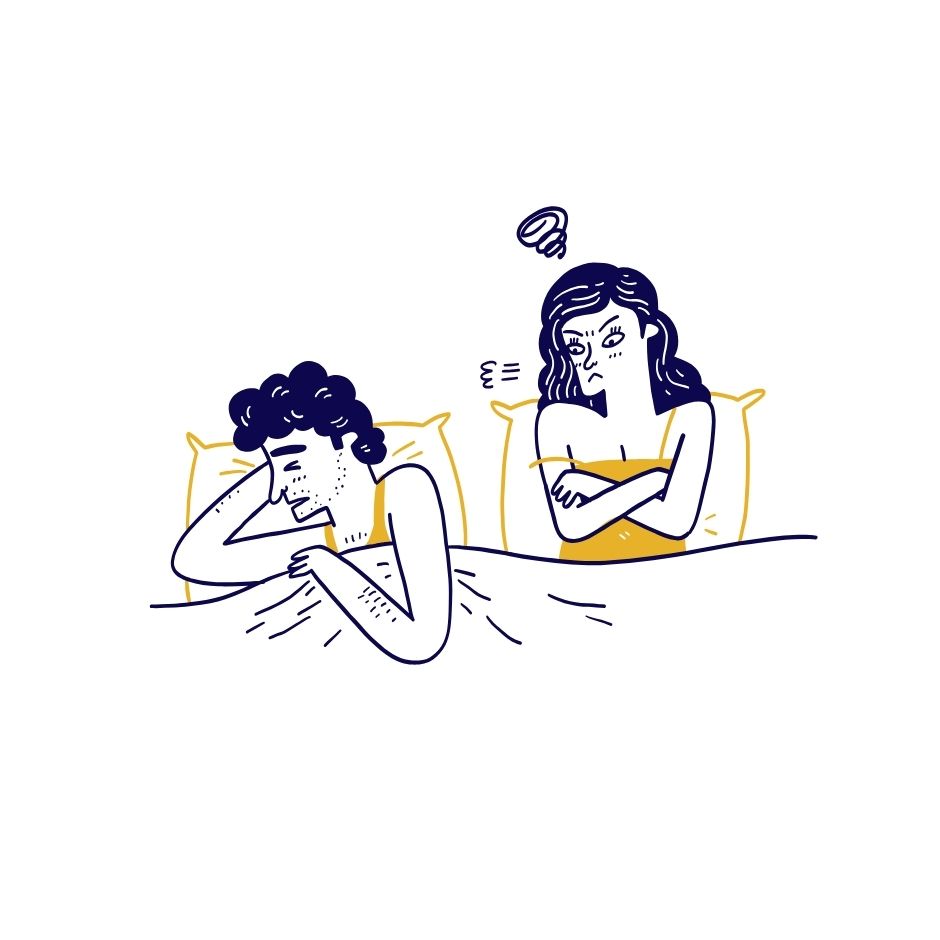
The inquiry becomes more complicated when into my uncertainty also enters another person’s desire. I almost know what I want, and then he expresses a firm position. I was fairly sure of my decision, and then she gets hurt. I wanted to say “no,” and the moment the person in front of me reacts I start negotiating with myself.
The goal is not to reach a state where you’re always confident in yourself. The work is to stay close enough to yourself to clarify what you think and what you want even in the presence of another person’s desire. In my view, this is one of the deeper meanings of differentiation: to hear the person in front of me without losing the ability to hear myself as well.
You can start precisely with the small choices. Before you agree, check if the *”yes”* you’re about to say is truly your *”yes.”* Before you go back on it, check if something new became clear to you or if it simply became harder to hold a different position. Even the sentence “I want to think about it” can create the space needed for clarification.
When you become more present in your life, something in the relationships around you may shift. People who got used to you agreeing can be surprised when you refuse. Someone who got used to you always being available may struggle with the change, and a family that knows you in a certain role may continue to expect you to fill it.
Their response is information worth listening to. You too can make mistakes, hear criticism, apologize, be flexible, and change your mind. You can listen to the person in front of you seriously, without handing them the authority to decide what’s right for you.
In such moments I suggest pausing and checking: “What belongs to me here, and what belongs to the person in front of me?” Perhaps an apology belongs to me. Perhaps a correction belongs to me. Perhaps the responsibility to stand behind my choice belongs to me. The disappointment, the anger, or the disagreement of the other person can remain with them.
This is not an invitation to ignore your impact on others. It’s an invitation to take more precise responsibility. To see your part, to be willing to correct it when needed, and not to take on the other person’s part as well.
Take three sheets of paper and place them on the floor at a distance that feels comfortable to you. On the first write “The family I came from,” on the second “Me,” and on the third “My life.” Place them as feels right to you and begin by standing on the sheet that represents you.
Look toward the sheet that represents the family you came from. There’s no need to interpret what you’re feeling. Stay for a moment with the simple fact that you came from this family. If the sentences fit you, say: “You are the family I came from. I belong to you. I received life through you.”
Acknowledging belonging does not mean everything in the family was good. It does not require forgiveness, reconciliation, or closeness with someone who does not treat you well. It acknowledges what cannot be changed: this is the family you came from, and life reached you through your parents.
Check if there’s something you’re used to carrying for them—their mood, their disappointments, their conflicts, their choices, or the need for them to feel good. If something like that arises and fits you, you can say: “What belongs to you I leave with you with respect. I am the daughter. You are the big ones and I came after you.”
Now turn your body toward the sheet on which is written “My life.” If it fits you, say: “The life I received through you I take with me. Now I turn toward my life.” Move to stand on the sheet and notice what happens in the body, without looking for a particular sensation and without trying to reach a result.
From this place check what one choice in your life is asking you now to listen more to yourself. It can be a conversation, a request, a “no” you want to say, or a “yes” to something you want to choose. Take from the exercise only what feels accurate for you.
If you grew up without supportive family backing, you may have learned that belonging is tied to adjusting, and sometimes also to taking responsibility for what happens around you. Today, as an adult woman, you can check another possibility: to belong without disappearing. To love and remain separate, to be considerate and hold a position, to listen to others and keep space for your voice as well.
You can acknowledge that your parents came before you and that through them you received your life, without turning yourself into someone responsible for their lives. You can leave with them what belongs to them and take responsibility for what belongs to you—your choices, your relationships, and the way you want to live the life you received.
You’ve learned to listen to everyone. In that attentiveness there’s also a precious ability: to see people, to feel them, and to be in relationship. Now you can add to it another distinction—what belongs to them, what belongs to me, and what I want to do with my life.

+
For people without a supportive family network.
We will reveal how the lack of a family network challenges and strengthens the couple's relationship, the high prices it exacts from you and your relationship.
Couples therapy will strengthen your sense of security and belonging, so you can be close without losing yourselves along the way.
Online / In-person clinic

+
Individual therapy is a safe space where you will rediscover your strengths, build inner confidence, and create a whole and meaningful life for yourself, just as you dream.
Online / In-person clinic
+
You are invited to enter a unique space: an interactive conversation with special GPTs I created – a first-of-its-kind tool that looks inward with you in the language and frequency of the systemic constellation.
If there is something unresolved in your relationship, family, or heart – the chat will gently meet you without trying to fix it, inviting a different, slow, precise, and quiet perspective. There is no need to understand, just to see and let it work.
Expert in couples therapy for relationships without a supportive family safety net.
Developer of the Couples Constellation approach: a systemic-emotional therapy that brings the couple’s relational dynamics into contact with unspoken family patterns, alongside practical tools that enable movement, connection, and the creation of a deep partnership.




Let’s start with a brief introductory call, free of charge and commitment.
Sometimes, this small step changes everything.
The sessions take place
online via Zoom / face-to-face in Tivon, according to your choice