Home / “If you wanted me, you’d want sex”: When the gap in sexuality becomes a test of love
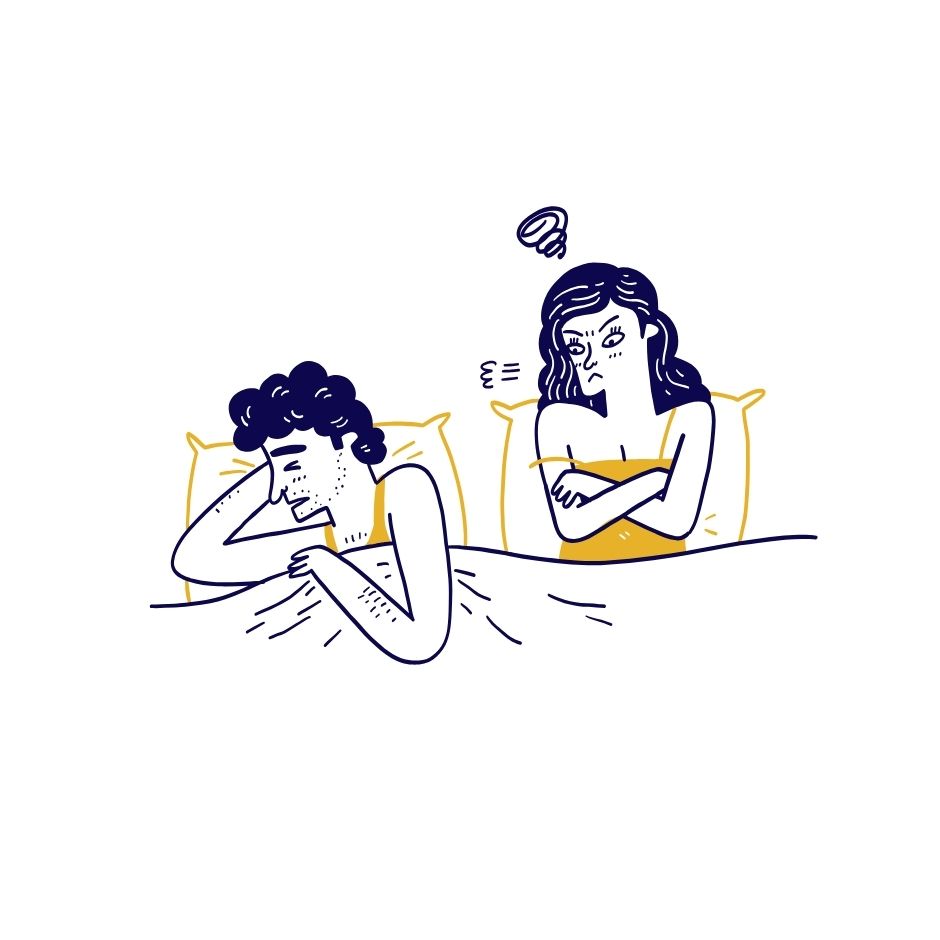
“I’m always the one who initiates. If I don’t start, a month can go by and nothing happens.”
“I’m already afraid to hug him. I don’t know if the hug can just stay a hug, or if I’ll have to explain again why I don’t want to continue.”
A gap in sexual desire starts to hurt long before anyone counts how many times we had sex this month. It hurts when one partner feels again and again that they want more, and the other feels again and again that more is wanted from them than they want to give, and then the conclusions arrive:
At this point, sex already holds much more than sex. It becomes a measure of love, attraction, closeness, and worth. Every initiation and every refusal takes on meaning, and both partners may find themselves trying to get through sexuality an answer to a much deeper question: Am I still loved and desired in your eyes?
Two people don’t arrive at a relationship with the same sexuality. Even within a long-term relationship, each person’s desire can change at different times and be affected by age, stress, physical and mental state, medications, parenthood, relationship quality, sense of security, and body image.
The mere fact that one partner wants more doesn’t yet tell us what the state of the relationship is. What happens between the partners around the gap tells us much more. I can want you more than you want me and experience pain. I can feel lonely, frustrated, and undesired. This experience is real and deserves space. The question is what I do with this pain, and especially what meaning I give it.
A gap in desire is one example of something broader that happens when two people who love each other want different things. I wrote extensively about the possibility of staying close even within difference in the article on gaps in relationships.
Sexual rejection touches a vulnerable place. The desire of the person we love can make us feel desired, loved, and wanted. When they don’t want sexual contact at that moment or at the same frequency we want, it’s easy to move from our experience to a conclusion about ourselves, about them, and about the relationship.
There’s a significant difference between “It hurts me that you don’t want to right now” and “You’re no longer attracted to me.”
There’s a difference between “I feel rejected” and “If you loved me, you’d want to sleep with me.”
The pain belongs to me and it’s real; my interpretation of what you feel toward me requires checking.
When I need your desire to know I’m loved, every “no” takes on enormous weight.
It’s no longer a response to a particular sexual invitation. It can sound inside me like “I don’t want you,” “You no longer attract me,” or even “I don’t love you enough.”
Through the lens of worthiness, a deeper question arises: Can I continue to know I’m worthy even in the moment when the person I’m with doesn’t want sexual contact?
This stance asks me to feel the pain and stay connected to my worth. The desire of the person facing me matters to me, and it can touch me deeply, yet their body doesn’t determine how worthy I am and how worthy I am of love.
The love test works in the other direction too. If every time I say “no” you get hurt, withdraw, become angry, or cast doubt on the relationship, I can start learning that my boundary hurts you.
Gradually, a different equation can form inside me: if I love you, I should want to, and if I don’t want to, maybe I should respond so you won’t feel rejected. From here, sexuality can develop that happens out of a desire to prevent disappointment, restore peace, maintain closeness, or prove the relationship is still okay.
Differentiation allows me to meet your disappointment and stay connected to myself. I can see that it hurts you, be sensitive to that pain, and say “I don’t want to right now.” I can also bear the fact that you’re disappointed in me at the moment, maintain my boundary, and recognize that your disappointment is real.
I expanded on the ability to stay connected to ourselves even facing the disappointment of the person we love in the complete guide to differentiation in relationships.
My love for you isn’t measured anew each time through my ability to generate desire, and the fact that I want less leaves me a full partner in the conversation about our sexuality.
One partner feels they’re missing sexual contact and therefore initiates more, raises the topic, checks if something will happen tonight, and tries to understand why the other doesn’t want to. The other partner starts experiencing sexuality as an area where there’s expectation. As the pressure grows, they may withdraw more.
The withdrawal increases the pain and anxiety of the first, who tries again to get closer. After a while, even touch that was once simple takes on new meaning. A hug is no longer necessarily just a hug, and a kiss can raise the question of where it’s supposed to lead.
The person who wants less starts being careful about touch so as not to create expectation. The person who wants more also experiences the decrease in non-sexual touch as further proof of distance. This way each reacts to the other’s reaction and the cycle strengthens.
As anxiety around sexuality rises, reactivity also rises. One tries to achieve more closeness to calm down, and the other tries to achieve more distance to calm down. Attention shifts more and more to what the other is doing and less to what’s happening inside me and to the way I myself participate in the cycle.
A gap in desire that could have remained a difference between two people becomes a whole system of tests: Do you want me, am I attractive enough, can I get close without committing to sex, can I refuse and stay close to you.
The work begins when each person manages to identify their part in the cycle and ask what they do when anxiety rises.
I can bring my sexual desire into the relationship in a clear, direct, and vulnerable way.
These sentences tell you about me. They leave you the possibility to feel differently than I do.
The differentiation lies in my ability to stay connected to my desire even when you don’t respond to it. I can want, ask, be disappointed, and talk about the meaning of sexuality for me. I can also check if beneath my desire lies an additional need: for you to prove I’m still desirable, to confirm our relationship is secure, or to help me feel worthy again.
Your body and desire remain yours.
From the other side, I can say I don’t want sexual contact right now. My responsibility is to be honest about myself and be willing to meet with you the broader question of sexuality between us.
A gap in desire invites partners to look for the person who has the problem.
Once one partner is defined as the problem, the other can stop looking at themselves. Through the lens of differentiation, the more interesting question is what each of us does within the gap.
The person who wants more can check what happens to them when told no. What meaning do they give the refusal? Are they able to bring their desire without turning it into a demand? Do they punish for disappointment through anger, coldness, silence, or withdrawal? Do they need sex also to receive confirmation that they’re loved and desired?
The person who wants less can check what happens to them facing the desire of the person they’re with. Are they able to talk about their sexuality directly? Are they waiting for the other to stop wanting so they won’t have to meet the gap? Are they using avoidance instead of saying something that’s hard for them to say? Are they agreeing to contact they don’t want because it’s hard for them to bear the other’s disappointment?
Worthiness also includes integrity. I can know I’m worthy and at the same time identify my behavior that harms the relationship and take responsibility for it.
If my sense of worth depends on you wanting me, every refusal from you can become a threat. I need your response to feel desirable.
On the other side too, worthiness can erode. If I believe that to be a good and loving partner I need to respond to your desire, I may distance myself from my body and from the ability to feel what I really want.
Worthiness allows two people to remain of value even within the mismatch. I’m worthy even when you don’t want sexual contact now. You’re worthy even when I’m disappointed in you. I can set a boundary and remain a loving partner, and I can want more from you without turning my desire into shame or defect.
From this stance, sex can stop serving as a continuous test of the relationship. We can start talking about sexuality itself: what feels good to us, what we’re missing, what turns us off, what arouses us, and what we’d like to create together.
When talking about a gap in desire, it’s worth checking also how each person’s desire awakens. In one person, sexual desire can appear on its own, even before contact is made. In the other, desire can start from a neutral state and awaken when there are conditions that suit them, like privacy, calm, closeness, a sense of connection, and pleasant touch.
The distinction between spontaneous desire and responsive desire can change the story partners tell themselves. A person who didn’t think about sex during the day can discover desire after the conditions in which their desire awakens were created. Therefore the sentence “I always want and she never wants” may describe only part of what’s happening between them.
This distinction invites us to be curious about how our desire works. Instead of quickly using the number of initiations as proof of the degree of attraction or love, we can check what allows each of us to approach sexuality.
In a persistent gap, a division of roles can form. The person who wants more becomes responsible for sexuality: they initiate, raise the topic, and try to find solutions.
The person who wants less becomes the one who decides if there will be sexuality and when.
This division leaves both trapped.
Shared responsibility can exist even when desire differs. It requires both partners to be present regarding the sexual life they share. The person who wants more can ask themselves what they’re seeking through sex: pleasure, touch, closeness, a sense of being desired, calming after distance, or security in the relationship. They can check which of these needs are deeply connected for them to sexuality and which can receive space in additional ways too.
The person who wants less can be interested in their desire with the same seriousness. What allows me to get close? What turns me off? How do I experience sexuality between us? What would I want to happen differently? What’s hard for me to say to the person I’m with?
The responsibility is shared. The answers can remain different.
A gap in desire can also be related to the body and mental state. Hormonal changes, medications, pain during sex, depression, anxiety, stress, fatigue, illness, changes in body image, and previous sexual experiences can affect desire.
Significant or persistent change in desire, pain, or difficulty in sexual function warrant appropriate medical or professional clarification. It’s worth leaving open the possibility that sexuality is affected by several factors simultaneously.
This is an especially important distinction when the gap has already become a test of love. A decrease in desire can hurt a partner very much, yet it’s worth clarifying what’s happening before drawing from it a conclusion about the degree of love, attraction, or commitment in the relationship.
Within couples work, I’m also interested in the question of what we do with the gap after it’s already between us. Are we able to be interested in it, or does every conversation about it become a trial where one is accused and the other defends?
A conversation about sexuality happens differently when I stop explaining to you who you are and start telling you what’s happening in me.
Instead of “You never want me,” it’s possible to say: “Sexuality between us matters to me. When it hardly happens I feel pain and distance, and I want us to talk about what’s happening between us.”
Instead of “All you care about is sex,” it’s possible to say: “When I feel that every touch might turn into a sexual initiation, I start avoiding even touch I actually want. I want us to be able to be close without me having to know in advance where the touch will lead.”
The difference is deeper than successful phrasing. I bring you my experience without turning it into a truth about you. I say what I want and leave you responsibility for your desire. I maintain my boundary and stay within the relationship.
The hardest part is staying in the conversation even when your experience isn’t the experience I hoped to hear.
Take a page and think about the last time a gap in sexual desire between you hurt you.
There’s no need to analyze your partner. This reflection is about what’s happening in you.
Write and complete the sentences:
Stop for a moment and notice the difference between what happened and the meaning you gave it.
“He didn’t want to have sex with me” is a description of what happened.
“I no longer attract him” is a meaning I give to what happened.
“She wanted sex and I didn’t” is a description of the gap.
“I disappoint her and I’m not a good enough partner” is a conclusion about myself.
Now add one sentence:
Maybe it’s the way you react to refusal, maybe the avoidance of conversation. Maybe the tendency to agree when you don’t want to. And maybe the anger, the withdrawal, or the need to receive from the person facing you confirmation that you’re still desired and loved.
There’s no need to solve the desire gap at the end of the exercise. Try to see a bit more clearly what actually happened, what meaning you gave to what happened, and what’s in your responsibility.
A gap in desire brings us face to face with a complex fact: my desire and your desire don’t always meet.
I can feel pain when you don’t want sexual contact and maintain my worthiness. I can not want and stay present in your pain. I can want change in our sex life and leave you full ownership of your body. I can set a boundary and bear the fact that you’re disappointed in me.
The gap in sexuality starts managing the relationship when it’s required to answer again and again questions it can’t answer alone: how much you love me, how much I attract you, how much I matter to you, whether we’re still okay.
Couple sexuality takes place between two people with their own body, desire, and boundaries. Deep intimacy allows us to meet also the difference between us, without turning every “yes” into proof of love and every “no” into proof of rejection.
I can want you without your desire determining how worthy I am. I can not want sexual contact right now without my boundary determining how much I love you.

+
For people without a supportive family network.
We will reveal how the lack of a family network challenges and strengthens the couple's relationship, the high prices it exacts from you and your relationship.
Couples therapy will strengthen your sense of security and belonging, so you can be close without losing yourselves along the way.
Online / In-person clinic

+
Individual therapy is a safe space where you will rediscover your strengths, build inner confidence, and create a whole and meaningful life for yourself, just as you dream.
Online / In-person clinic
+
You are invited to enter a unique space: an interactive conversation with special GPTs I created – a first-of-its-kind tool that looks inward with you in the language and frequency of the systemic constellation.
If there is something unresolved in your relationship, family, or heart – the chat will gently meet you without trying to fix it, inviting a different, slow, precise, and quiet perspective. There is no need to understand, just to see and let it work.
Expert in couples therapy for relationships without a supportive family safety net.
Developer of the Couples Constellation approach: a systemic-emotional therapy that brings the couple’s relational dynamics into contact with unspoken family patterns, alongside practical tools that enable movement, connection, and the creation of a deep partnership.





Let’s start with a brief introductory call, free of charge and commitment.
Sometimes, this small step changes everything.
The sessions take place
online via Zoom / face-to-face in Tivon, according to your choice