Home / How to start a new relationship without repeating patterns of a toxic relationship
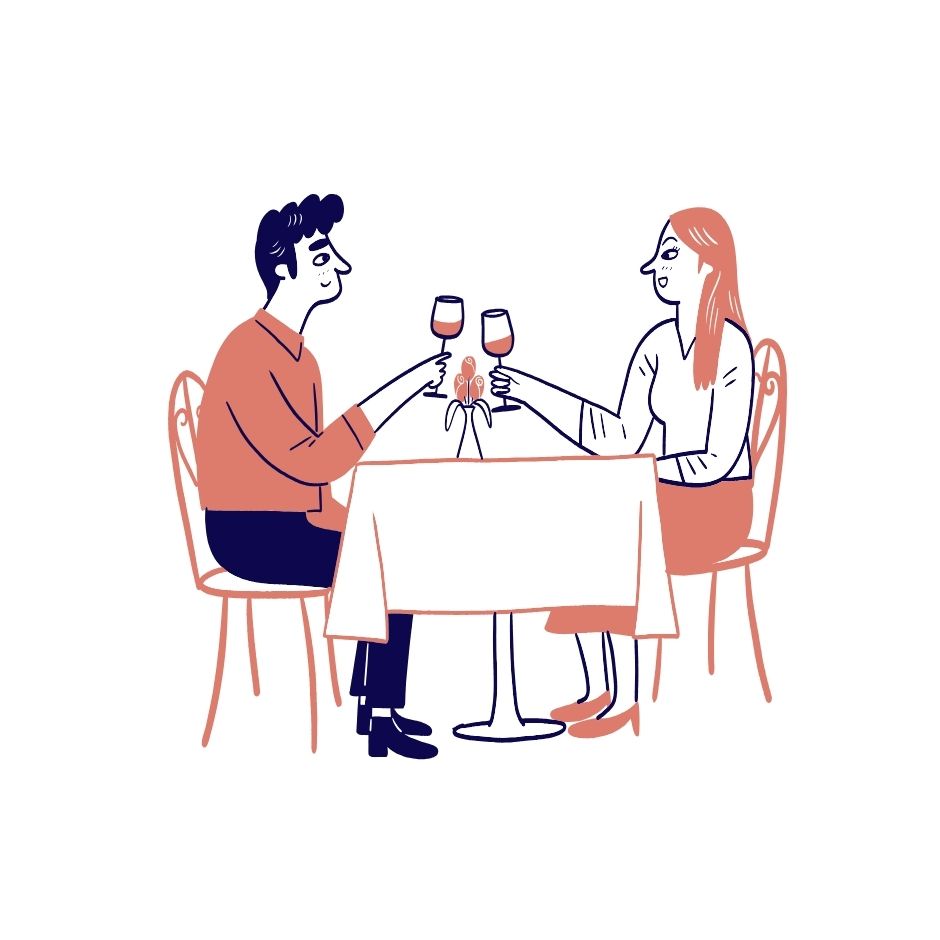
You meet someone nice. The conversation flows, you feel comfortable with him, something in your heart even opens. And then your body goes on alert. Your breathing shortens, a small thought says “be careful,” and the desire to get close meets an urge to pull away.
After a toxic relationship, a new beginning can be especially confusing. You want love, and at the same time you don’t want to find yourself again in a relationship where you get lost. You already know what the cost of ignoring what you feel can be, so any discomfort can take on great weight.
The challenge now is to learn to listen to yourself without letting the previous relationship run the new one. To recognize a warning sign when it’s there, without turning every fear into proof that something bad is about to happen. To let a new person get close, and stay close enough to yourself to see who is really in front of you.
A toxic relationship doesn’t necessarily end inside us the day we broke up. Months or years of walking on eggshells, guessing moods, criticism, uncertainty, or undermining what we feel and think can leave us vigilant even when the relationship is already behind us.
The body can continue to pay attention to tone of voice, a small change in facial expression, the time that passes until a message gets a reply. It learned to look for early signs of what might be coming, and that learning doesn’t necessarily disappear because the person in front of us has changed. This can create a confusing experience: you want closeness and get scared when it arrives. You wait for a message and when it comes you want to pull away. You enjoy the meeting and on the way home you start dissecting and analyzing every sentence said in it.
Your vigilance tells you something real about your experience; it still doesn’t tell you on its own who the person in front of you is.
This is one of the important distinctions at the beginning of a new relationship after a toxic relationship. Something uncomfortable happens inside you and you want to know whether to trust the feeling. I suggest not rushing to either of two possible conclusions: that the fear proves the new person is dangerous, or that the fear belongs to the past and therefore doesn’t need to be addressed.
If every vigilance becomes a red flag, the previous relationship continues to determine who will be able to get close to you. If every vigilance gets the label “it’s just my trigger,” you might use the psychological explanation to dismiss yourself.
There’s a third option: to check.
Discernment requires me to take my experience seriously without turning every interpretation of mine into fact. I can feel fear and still check if there’s danger. I can feel attraction and still check if the person in front of me is good to me.
This is a more mature stance than the need to know immediately.
Say you tell the new person you want an evening to yourself and he sounds disappointed. Something in your body contracts. Your shoulders tense, your breathing changes, and immediately an urge rises to explain at length, take it back, or suggest meeting anyway.
It’s worth listening to that response. It can tell you something about what’s happening inside you right now. Now you can also turn your gaze to the person in front of you.
Can he be disappointed and accept your choice? Is he trying to make you feel guilty? Does he keep pressing after you said no? Can you leave his disappointment with him without immediately turning it into your task?
The last distinction is especially important. A new relationship doesn’t require you to prevent the person in front of you from feeling disappointment, anger, or frustration. His ability to feel something that isn’t pleasant and your ability to stay true to your choice can both exist in the same relationship.
The body gives information.
His behavior gives information.
Your behavior also gives information.
You’re learning to see all three.
If the previous relationship left you with ongoing doubt in your own judgment, I expanded on the way to rebuild trust in your inner voice in the article Self-worth after a toxic relationship: How do you learn to believe in yourself again?.
You may know love that requires a lot of effort to receive. Maybe you’ve already been in relationships where you waited, chased, tried to understand what the other person feels, or worked hard to bring back closeness that disappeared.
You can check with curiosity where you’ve already known this movement. It can be connected to previous relationships, the family you grew up in, or the toxic relationship you left. The goal isn’t to find an explanation that will determine why you choose as you choose, but to expand your space of choice now.
A stable, available, and clear person can actually feel less exciting at first. A relationship that develops gradually may stir doubt because it doesn’t have the tension you’ve learned to identify as part of closeness.
The familiar isn’t necessarily good for you. By the same token, what’s new to you isn’t necessarily safe, so there’s no need to replace an old rule with a new rule. You need to get to know the person in front of you.
After a toxic relationship, the desire to find a sign that will guarantee this time everything will be different is understandable. Such a sign doesn’t exist; you can see something else: a pattern.
How does the person in front of me react when I say “no”? What happens when I want something different from him? Is he curious about my experience even when it doesn’t flatter him? Is he able to hear that he hurt me without immediately turning the conversation to what I did to him?
Alignment between words and actions is also revealed over time. An apology gains meaning when the behavior that follows it changes. A promise to respect a boundary gains meaning when you can see what happens the next time that boundary meets his desire.
It’s worth checking yourself too. Are you saying what you really want? Are you presenting yourself as you are, or trying to be the woman who will guarantee he’ll stay? Are you testing him endlessly while at the same time hiding significant parts of yourself from him?
A new relationship is built between two people. The question isn’t only whether he’s worthy of your trust; the question is also what kind of partner you choose to be in it. If you want to deepen the distinction between relationship difficulty and a relationship where you’re starting to lose yourself, you can also read the article 7 warning signs of a toxic relationship: How to recognize you’re starting to lose yourself in the relationship.
After a toxic relationship you can move quickly in one of two directions. Give yourself over to the new relationship and give up parts of yourself again to make sure the other person will stay, or keep a distance large enough that no one can really hurt you. In both situations fear still holds a large part of the wheel.
Discernment allows a different movement: to get close and stay connected to myself at the same time. I can be excited about someone and continue meeting friends. Want to see him and also keep the pace that works for me. Fall in love without rushing to hand over my entire life center to the new relationship.
I can also bring more of myself into the relationship. Say what I want. Say when something bothers me. Disagree. Carry the possibility that the person in front of me will be disappointed in me, and still not rush to turn his disappointment into proof I did something wrong.
This is also a movement of worthiness: knowing that my value doesn’t depend on the person in front of me being satisfied with me, choosing me, or approving my choices. I can want the relationship very much, and at the same time remain a separate person in it.
When the relationship becomes a place from which I ask again and again for my calm, security, and worth, it’s worth deepening also in the question of emotional dependency in partnership.
This also changes one of the central questions at the beginning of the relationship. Alongside “Will he choose me?” another question appears: “When I see who he is and when I remain who I am, do I want to choose this relationship?”
There’s no number of months that proves you’re ready for a new relationship. Even a long time outside of partnership doesn’t guarantee the past won’t show up when someone new gets close.
I’m looking for a different kind of readiness. Do you have enough ability to stay present inside uncertainty? To feel attraction without handing over your judgment to it? To feel fear without letting it decide for you either?
Are you able to say no and see what happens? Say yes and check if it’s really your yes? Do you have people, pursuits, and sources of meaning that don’t depend only on the new relationship?
You don’t need to arrive at the next relationship after you’ve solved yourself. You can arrive at it with more willingness to meet yourself in it.
The next time something in the new relationship activates you, pause the conclusion for a moment.
Notice what’s happening in your body. Where does the response appear? What happens to your breathing? What urge rises: to get close, to run away, to apologize, to explain, to attack, to please?
Now separate three things:
What happened: What did the person in front of me actually do or say?
What I interpreted: What meaning did I give to what happened?
What I did: How did I choose to respond?
This separation doesn’t cancel the emotion. It allows you to see it inside a broader picture.
You can say to yourself:
“I’m feeling something strong right now. I don’t have to dismiss it, and I don’t have to decide immediately what it proves.”
And then let time and more meetings provide additional information.
After a toxic relationship a hidden task can appear: this time I’ll do everything right. I’ll immediately recognize every sign, won’t ignore myself, and won’t repeat any mistake.
This is still a way to try to achieve certainty.
Partnership doesn’t offer that kind of certainty. A new person can disappoint you. You can be wrong in your reading of him. You can discover later something you didn’t see at the beginning. Even in a good relationship there will be moments when you’ll be hurt and moments when you’ll hurt.
The goal isn’t to become a woman who can no longer be hurt.
The more mature possibility is to be a woman who doesn’t abandon herself when the relationship becomes complex. A woman who’s able to check reality, take responsibility for her choices, set a boundary when needed, repair when she herself hurts, and change her choice when the reality she meets doesn’t suit her.
You don’t need to know in advance that this person will never hurt you. You need to be there to see who he is, and also see who you’re becoming when you’re with him.
Maybe this is one of the meaningful possibilities a new relationship offers after a toxic relationship: not to prove the past is behind you, but to discover you can love without handing over to another person the responsibility to hold yourself in your own place.

+
For people without a supportive family network.
We will reveal how the lack of a family network challenges and strengthens the couple's relationship, the high prices it exacts from you and your relationship.
Couples therapy will strengthen your sense of security and belonging, so you can be close without losing yourselves along the way.
Online / In-person clinic

+
Individual therapy is a safe space where you will rediscover your strengths, build inner confidence, and create a whole and meaningful life for yourself, just as you dream.
Online / In-person clinic
+
You are invited to enter a unique space: an interactive conversation with special GPTs I created – a first-of-its-kind tool that looks inward with you in the language and frequency of the systemic constellation.
If there is something unresolved in your relationship, family, or heart – the chat will gently meet you without trying to fix it, inviting a different, slow, precise, and quiet perspective. There is no need to understand, just to see and let it work.
Expert in couples therapy for relationships without a supportive family safety net.
Developer of the Couples Constellation approach: a systemic-emotional therapy that brings the couple’s relational dynamics into contact with unspoken family patterns, alongside practical tools that enable movement, connection, and the creation of a deep partnership.




Let’s start with a brief introductory call, free of charge and commitment.
Sometimes, this small step changes everything.
The sessions take place
online via Zoom / face-to-face in Tivon, according to your choice