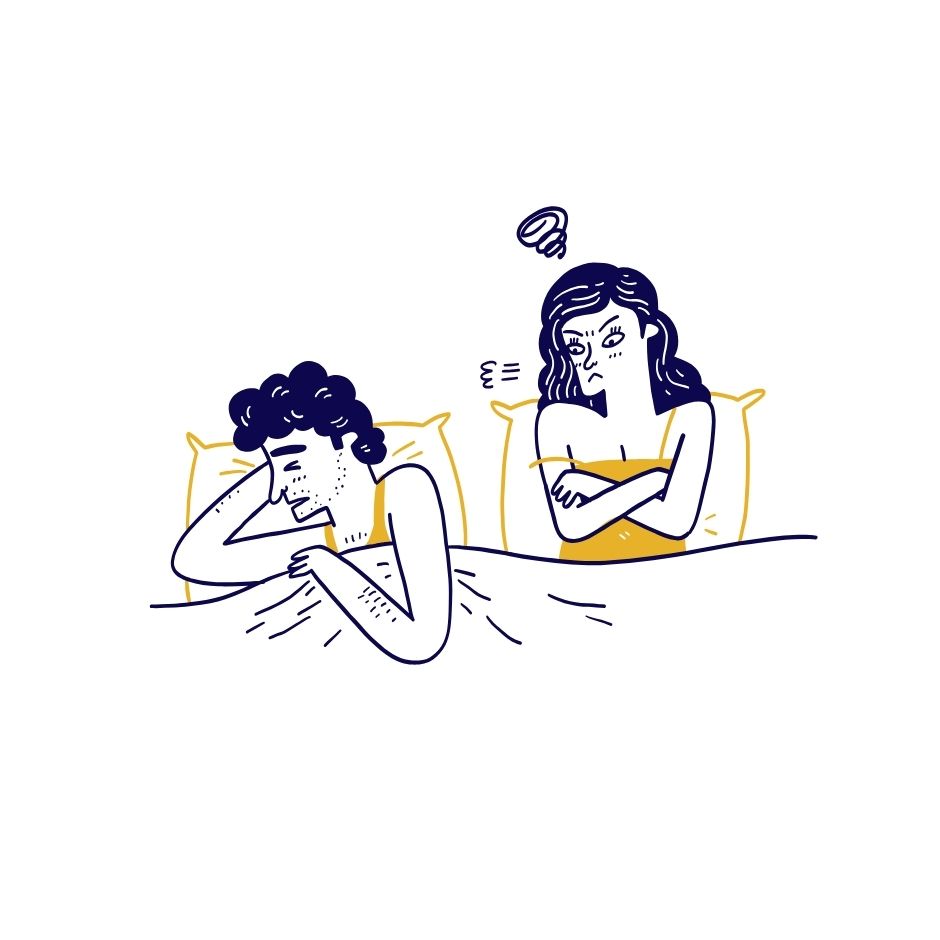
You already know something in this relationship isn’t good for you. You notice how careful you are, how many times you give up on a conversation because you don’t have the energy for what will come after, and how much energy goes into trying to understand what happened, who started it, whether you overreacted, whether you asked for too much.
Maybe you’ve already told yourself you need to leave. Maybe you even said it to a friend. And then comes a good day, a different conversation, an apology, closeness or a memory of who you once were, and you don’t know again.
From the outside the question can sound simple: if it’s so bad for you, why are you staying? Inside, contradictory things can live together. You can love him and be angry at him, want to distance yourself and miss him when he distances himself, know that something in the relationship is diminishing you and still hope he’ll change. You can want to stay and not agree anymore to live the way you’re living now.
You don’t have to resolve this contradiction right away. Even before deciding whether to stay or leave, you can start coming back to the person who’s supposed to make that decision: yourself.
You don’t have to decide today in order to start seeing
The need to decide whether to stay or leave can itself become a burden. Every event in the relationship becomes evidence in a trial you’re conducting inside yourself. After a fight you’re sure you need to go, and after a good weekend you think maybe it can be fixed after all. You collect evidence for both sides and wait for the moment when everything will be clear.
Clarity doesn’t always come that way. Before the question “Should I stay or leave?” you can get closer to what’s happening now and ask: “Who am I becoming inside this relationship?” Am I becoming freer or more careful? Is there room for my desires, and can I say I was hurt without fearing the response?
You can also check: “What do I already know, even if I still don’t know what to do with it?” Maybe you still don’t know whether to leave, and at the same time you already know that you’re afraid of him when he’s angry, that you’re no longer willing to accept a certain way of speaking, that you feel lonely inside the relationship or that you want to give this relationship another chance.
A position is not a decision. You can start identifying your position even before you know what action will grow from it.
The difficulty leaving doesn’t mean the relationship is good for you
We tend to think that if a situation is truly difficult, the desire to get out of it should be clear. Human relationships are more complex. You’re not only connected to what’s happening today. You’re connected to the person, to your history together, to the home you built, to children if there are any, to memories, to plans, to shared family, to the financial situation and to the future you imagined.
You can also be connected to hope. Maybe you’ve already seen him change for a period, maybe there were different years between you, and maybe you know sides of him that people on the outside don’t see. After a crisis can come closeness that reminds you exactly why you fell in love. All of these can exist alongside the fact that you’re being hurt.
You don’t need to turn him entirely bad in order to validate what’s hurting you. The good moments don’t erase the places where you’re being worn down. The difficulty leaving doesn’t mean the situation isn’t serious, and it also doesn’t make you weak, dependent or incapable. There’s a relationship here that has meaning in your life, and therefore the decision about it is also meaningful.
Before the big decision, check how much room is left for you
When we’re only busy with the question “Should I break up?” it’s easy to miss what’s happening day after day. Erosion inside a relationship can happen through small adjustments: you stop bringing up a certain topic, avoid meeting someone he doesn’t like, change the way you speak or express anger, and tell your friends less because you don’t want them to judge him, or you.
Each adjustment by itself can seem marginal. Over time it’s worth looking at the picture that forms. What am I no longer talking about in order to keep the peace? What have I stopped doing since I’ve been in this relationship? Where do I already know in advance which version of me will be accepted and which will provoke a reaction?
Another question touches on your ability to be two separate people: Can I say “no” and stay in the relationship even when the person facing me is disappointed? A couple relationship doesn’t require us to agree. It requires the ability to bear the fact that the person I love is a separate person from me. If your separateness itself repeatedly becomes a threat to the relationship, that’s information worth paying attention to.
If you’re trying to understand whether this is a difficult period in the relationship or a pattern that’s already diminishing you, I expanded on this distinction in the article 7 Warning Signs of a Toxic Relationship: How to Recognize You’re Starting to Lose Yourself in the Relationship.
Your body also holds information about what’s happening to you in the relationship
When you think about a certain conversation with him, notice what happens in your body. You don’t need to close your eyes, breathe in a special way or try to calm down. Maybe your shoulders tense, your breathing becomes short or your stomach contracts. Maybe an urge rises to explain yourself quickly, to apologize, to be silent, to flee or to end the conversation.
This response isn’t a verdict on the relationship. Your body isn’t deciding whether you should stay or leave. It’s giving you more information about what’s happening to you in a particular moment.
You can stay a few seconds with the sensation and check what happens when you don’t rush to explain it. Can you notice the fear without immediately convincing yourself you have no reason to be afraid? When I give space to the experience before I explain it, I can start recognizing things I’ve already gotten used to bypassing.
Coming back to myself doesn’t mean immediately distancing from my partner
You can start giving yourself back space even when you’re still inside the relationship. Call again the friend you distanced from, return to an activity that was yours, notice what you want before you check what he wants, and maintain contact with people who know you outside the relationship. You can also make a small decision without asking for approval about it.
These are seemingly simple actions, and their meaning is deep. When your entire emotional world is organized around the relationship, it’s hard to see it in perspective. Every change in your partner’s mood feels enormous, every distancing threatening and every good moment can become proof that maybe everything worked out.
The more you return to being a person who has other connections, other places of belonging, other desires and other sources of meaning, the more internal space is created to look at the relationship too. This is the possibility of being in a relationship without disappearing from it.
An internal boundary comes before declaring it
When a woman starts coming back to herself, a desire can arise to immediately set clear boundaries: to say what she’s not willing to accept, to refuse, to stand her ground. There’s a stage that comes before that. I need to start knowing inside myself where my boundary is.
Maybe the internal sentence is “The way you just spoke to me is not acceptable to me.” Maybe “I want to keep meeting this friend.” And maybe “I’m not willing for you to check my phone.” Even before I said the sentence out loud, there’s meaning in the fact that I’m able to hear it inside myself without immediately erasing it because the other person might get angry.
In a relationship that has the ability to listen, you can later bring the boundary into the relationship. Your partner can be hurt, angry or disagree, and still recognize that you are a separate person from him.
In a relationship that has intimidation, threats, monitoring, isolation, financial control, violence or ongoing attempts to control your freedom, the picture is different. Setting a boundary directly isn’t always the safest step. Coercive control is a broader pattern than a difficult fight or poor couple communication, and it can include isolation, monitoring, threats, restricting access to money or resources and ongoing diminishment of the other person’s freedom and autonomy. A systematic review and meta-analysis in the field found a connection between exposure to coercive control and PTSD and depression symptoms. To read the review on coercive control and its psychological implications.
When this is the type of relationship you’re living in, coming back to yourself also includes protecting your safety, connecting with people outside the relationship and reaching out for professional help that fits this reality. You don’t need to prove your separateness through confrontation that endangers you.
When there’s no family support system, the dilemma becomes bigger
When there’s no family support system, the question of whether to leave can be especially big. Separation doesn’t only threaten the relationship. It can threaten your sense of home entirely. If your partner is the central person in your life, the family you built and your main address in times of difficulty, the very thought of life without him can feel like falling without a net.
In such a situation there’s great value in building a support system even before a decision is made. One friend you can talk to honestly, a professional, a connection that broke off and can be carefully renewed, a community or a person who knows what you’re going through and doesn’t demand you choose immediately. Such support allows you to meet the question when you’re less alone.
I wrote about the weight we might place on the relationship when it becomes our central or only family in the article My Partner Can’t Be the Family I Didn’t Have.
When is there a possibility to work on the relationship?
Relationships can change. The question isn’t only how much you want to save the relationship, but what happens between the two of you when difficulty comes into the room. Are both of you able to recognize the impact of your behavior on the other? Can you hear pain without immediately turning the person in pain into the guilty one? Can each of you meet something about yourself without the whole conversation moving to dealing with the other’s flaws?
You can also check what happens to separateness. When you express a different position, can your partner stay with you in the relationship even when he doesn’t like it? When you say “no,” can he bear disappointment without demanding you cancel the boundary in order to calm him? And when he tells you something that’s hard for you to hear, are you also able to examine yourself without erasing yourself?
An apology after a crisis can be meaningful. Change is also visible in what happens in the weeks and months after: Is there more ability to talk, more responsibility, more freedom to be two different people and less need for one of you to diminish so the relationship stays stable.
When there’s real fear, violence, coercion or ongoing control, the question is no longer just how to improve couple communication. In such a situation what’s needed first of all is addressing the safety and the harm itself and choosing professional help that fits this reality.
You can be uncertain without leaving yourself
You might finish reading this article and still not know whether to stay or leave. You can still not know. Your position can start with the ability to feel something without canceling it, to know something without rushing to prove it, and to want something even when the person you love wants differently.
You can start coming back to talking with people you trust, noticing what’s happening in your body, bringing back into your life something that was yours and calling by name what’s hurting you. You can give space to love, to fear, to anger and to hope without demanding one of them immediately defeat all the others. From this place a decision can later grow.
If you choose to stay, it’s important that you be there. If you choose to leave, it’s important that you be there.
Even before you know what will happen to the relationship, you can start bringing back to yourself the person who will live with the choice.